
Building a website has never been easier.
With today’s AI website builders, a business owner can describe a company, choose a style, generate pages, add content, and publish a functional website in a remarkably short time. Many current platforms combine AI-generated layouts and content with visual editing, hosting, SEO tools, analytics, and other built-in business features.
But there is a more important question to ask:
Is getting a website online the same as building the right digital system for your business?
That distinction matters.
A website can look professional and still fail to generate qualified enquiries. It can rank reasonably well and still provide a poor buying experience. It can collect leads and still leave sales teams manually following up with every enquiry.
This is where the comparison between an AI website builder and professional website development becomes more nuanced.
The real question isn’t whether AI can build a website. It can.
The real question is what you need your website to accomplish.
If you need a simple company website, portfolio, landing page, or online presence, an AI website builder may be more than capable of meeting your requirements.
But if your website needs to support a complex customer journey, generate and qualify leads, connect with your CRM, integrate with business processes, automate repetitive work, provide meaningful analytics, or become part of your sales and growth infrastructure, the requirements are very different.
This article is part of our AI Website Development series. For the complete framework, read AI Website Development: The Complete Guide to Building Smarter, Faster & Better Websites with AI.
Professional website development is therefore not simply about having a person build what AI can generate.
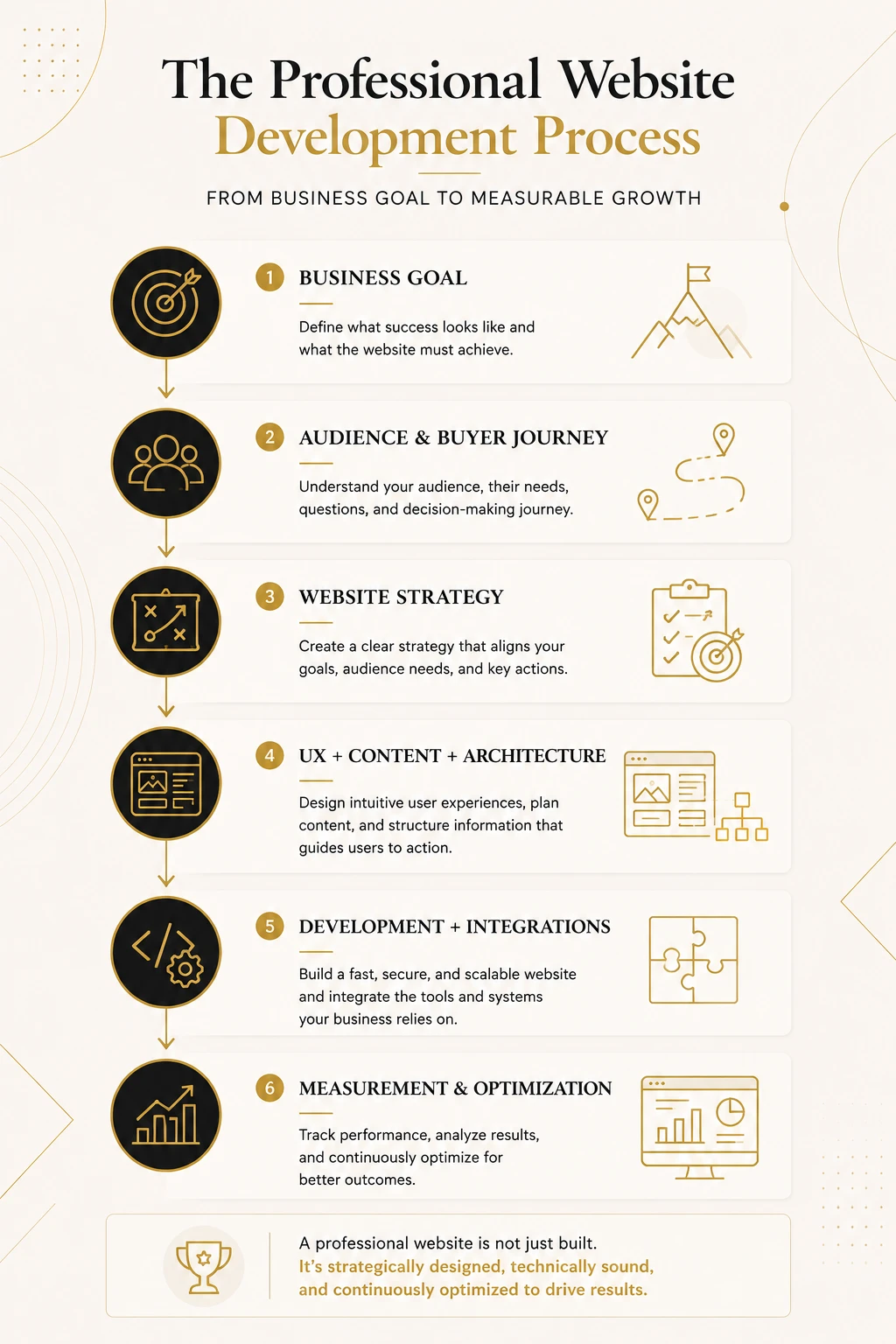
It is about understanding the business goal, identifying what the website needs to accomplish, designing the appropriate digital system, implementing the right technology, and measuring whether the system produces the intended business outcome.
And increasingly, the choice does not have to be AI versus professionals.
A third approach is emerging: AI-assisted professional website development, where AI accelerates research, content, design, development, testing, and optimization while human expertise remains responsible for strategy, architecture, business logic, integration, quality, and accountability. This is the broader approach we explore in our guide to AI website development, where AI is used as part of a structured website development process rather than simply as a website-generation tool.
In this guide, we’ll compare these approaches and help you determine which one makes sense for your business.
The best approach isn’t necessarily the one that builds a website fastest. It’s the one that solves the business problem effectively.
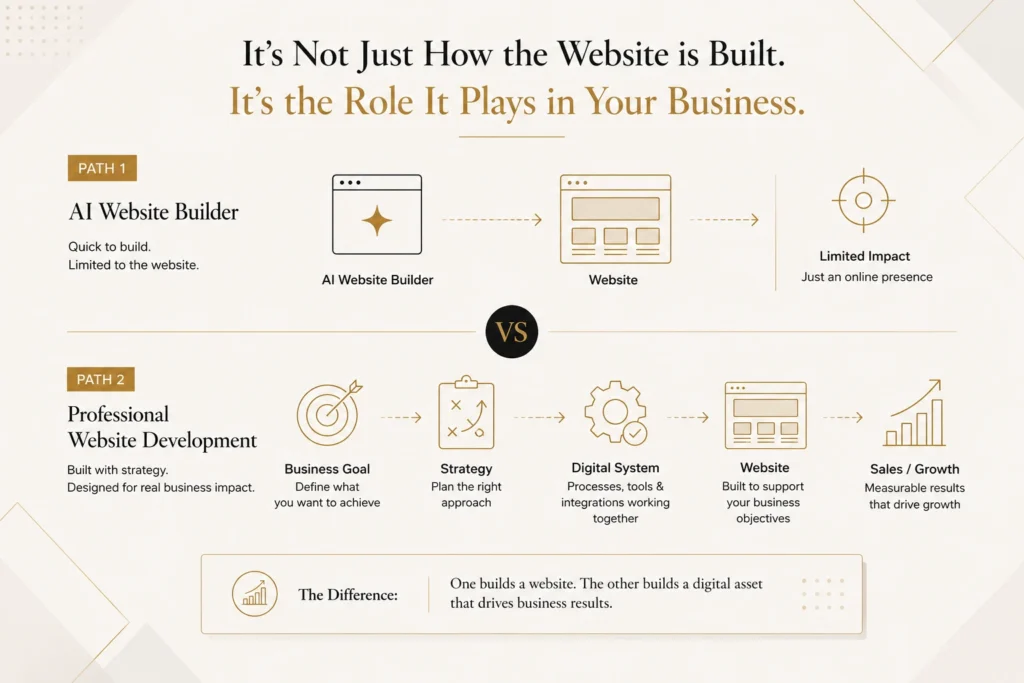
Table of Contents
What Is an AI Website Builder?
An AI website builder is a website creation platform that uses artificial intelligence to automate parts of the website-building process.
Instead of starting with a blank canvas, you typically describe what you need—such as your business type, services, target audience, and preferred style—and the platform generates an initial website structure, design, content, or other website elements.
The exact capabilities vary between platforms, but the underlying idea is similar:
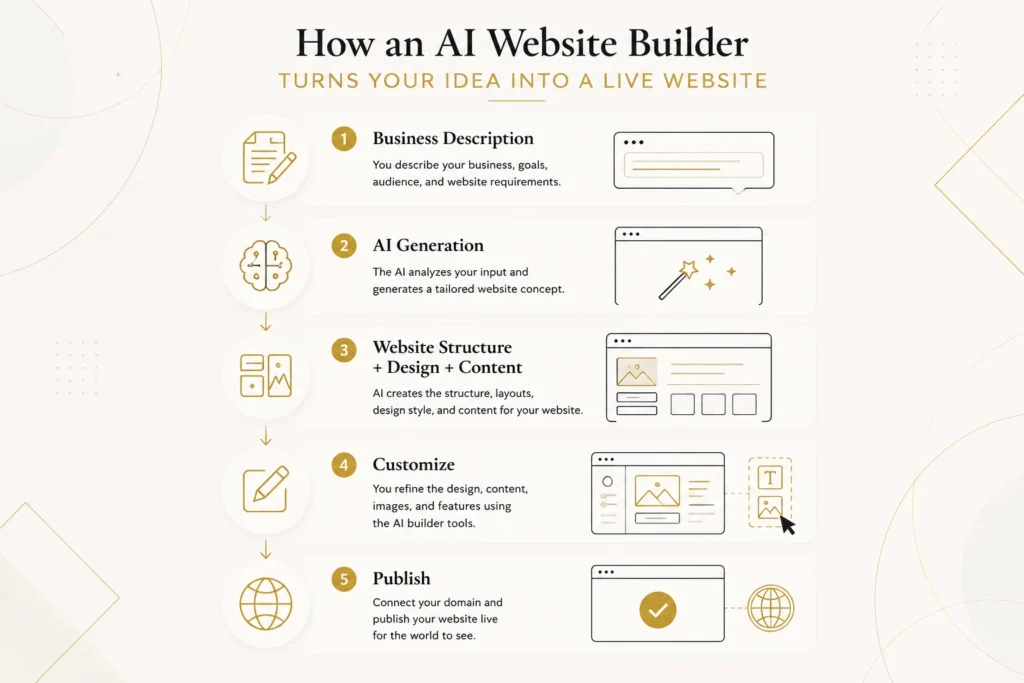
You provide the direction → AI generates the starting point → You customize → The platform publishes the website.
Modern AI website builders have moved beyond simply generating a few pages. Many now combine AI generation with visual editing, templates, hosting, domains, content assistance, SEO features, forms, analytics, and integrations.
This makes them a legitimate option for businesses that primarily need to get a functional website online quickly without investing in a highly customized development process.
But understanding what an AI website builder can generate is only the first step. The more important question is whether what it generates is appropriate for the business problem you are trying to solve.
How Do AI Website Builders Work?
Most AI website builders follow a relatively simple workflow:
1. Describe the business
You provide information about your company, industry, services, audience, and website requirements.
2. AI generates the initial website
The platform creates some combination of:
- Page structure
- Layouts
- Website copy
- Images or visual suggestions
- Navigation
- Calls to action
- Basic design elements
3. Customize the result
You can usually modify the generated website using a visual editor, templates, AI prompts, or other built-in tools.
4. Connect basic website functions
Depending on the platform, you may be able to add forms, analytics, SEO settings, domains, email, ecommerce functionality, or third-party integrations.
5. Publish
The website is hosted and made available online through the platform.
This process removes much of the technical work traditionally associated with creating a website, which is one of the biggest advantages of an AI website builder.
What Can AI Website Builders Do Today?
The capabilities of AI website builders have expanded considerably.
Depending on the platform, an AI website builder can help with:
Website structure
Generate pages and navigation based on a description of the business.
Design and layouts
Create an initial visual direction, page sections, typography, and responsive layouts.
Content creation
Generate or refine headlines, service descriptions, calls to action, and other website copy.
Images and visual assets
Suggest, generate, or help source imagery for different sections of a website.
Basic SEO
Assist with page titles, descriptions, headings, image information, and other basic optimization tasks.
Forms and lead capture
Add contact forms and other basic mechanisms for collecting enquiries.
Hosting and publishing
Many platforms combine the website builder with hosting and domain management.
Analytics and integrations
Depending on the platform, basic analytics and integrations with other business tools may also be available.
This means the old assumption that an AI website builder can only create a basic template is no longer accurate.
For many straightforward requirements, AI can now handle a surprisingly large portion of the website creation process.
The question is what happens when the website needs to do more than present information.
Who Is an AI Website Builder Best Suited For?
An AI website builder can be a sensible choice when the primary objective is speed, simplicity, and getting an online presence established.
For example, it can work well for:
- A new business that needs a basic website
- A consultant or professional establishing an online presence
- A small company with straightforward requirements
- A landing page for a campaign
- A temporary or event-based website
- An early-stage business validating an idea
- A simple portfolio or service website
- An MVP that needs to be launched quickly
In these situations, investing heavily in custom development may create unnecessary complexity.
If the business simply needs:
“A professional-looking website that explains what we do and gives people a way to contact us,”
an AI website builder may be entirely appropriate.
The decision changes when the website becomes an important part of how the business generates leads, supports sales, connects systems, automates processes, or serves different customer journeys.
That is where the distinction between an AI website builder and professional website development becomes much more important.
What Is Professional Website Development?
Professional website development is more than having someone design and build a set of web pages.
It is a structured process of turning a business requirement into a digital experience and technical system that supports a specific outcome.
Depending on the business, that may involve:
- Understanding business objectives
- Defining the target audience and buyer journey
- Planning the website structure and information architecture
- Designing the user experience
- Developing the website
- Connecting business tools and third-party services
- Implementing analytics and measurement
- Testing performance, accessibility, security, and usability
- Launching and maintaining the system
- Continuously improving it based on real-world results
The important distinction is that professional development starts with what the business needs the website to accomplish, rather than simply asking what pages need to be created.
For a company that only needs an online presence, this process may be relatively simple.
For a business that depends on its website for lead generation, sales enablement, customer education, recruitment, ecommerce, or operational workflows, the scope can become significantly more sophisticated.
It Starts With the Business Goal
A professional website project should begin with questions such as:
What are we trying to achieve?
Who needs to use the website?
What decisions do those people need to make?
What should happen after someone visits the website?
How will we know whether the website is working?
For example, a manufacturing company may not simply need a website that explains its capabilities.
Its actual objective may be to:
Attract the right buyers → demonstrate technical credibility → help buyers evaluate capabilities → generate RFQs → route enquiries to sales → track opportunities.
The website is therefore only one part of the overall system.
This changes the way the website is planned.
Instead of starting with:
“Which pages should we create?”
the process starts with:
“What business outcome should this digital experience support?”
Strategy Comes Before Development
Once the business objective is understood, professional development typically involves translating that objective into a website strategy.
This can include:
Information architecture
Determining how information should be organized so visitors can find what they need and move through the website logically.
Customer journey
Understanding what different audiences need at different stages of their decision-making process.
Conversion architecture
Designing calls to action, enquiry paths, forms, landing pages, and other elements around the desired business outcome.
Content strategy
Determining what information the business needs to communicate, what questions buyers are likely to have, and what evidence is required to build confidence.
Technical architecture
Determining how the website should be built, what integrations are required, what data needs to move between systems, and how the platform should evolve over time.
This is where professional website development becomes less about building pages and more about designing a system.
Professional Development Also Handles the Complexity Behind the Website
A website may look simple from the outside while having significant complexity behind it.
For example, a business website might need to connect with:
- CRM systems
- Marketing automation
- Email platforms
- Analytics platforms
- ERP or inventory systems
- Payment gateways
- Customer portals
- Booking systems
- Lead qualification workflows
- Internal databases
- AI-powered tools
The website may be the interface customers see, but the real business value can come from the systems working behind that interface.
Professional development is useful when those requirements need to be designed, integrated, tested, secured, and maintained as a coherent system.
Quality Is More Than Visual Design
A professional website also needs to work reliably across different devices, users, browsers, and situations.
That means considerations such as:
- Responsive behaviour
- Performance
- Accessibility
- Security
- Usability
- Form reliability
- Error handling
- Analytics
- Search visibility
- Maintainability
- Scalability
Accessibility, for example, is not simply a visual preference. The W3C’s current WCAG 2.2 standard provides testable accessibility criteria covering areas such as perceivability, operability, understandability, and robustness.
This illustrates an important point:
A professional website is not judged only by how it looks when it is first published.
It also needs to perform its intended function reliably after launch.
Professional Development Does Not Mean Everything Must Be Built From Scratch
This is an important distinction.
Professional website development does not necessarily mean custom coding every component.
A professional team may use:
- CMS platforms
- Website frameworks
- Existing components
- APIs
- SaaS tools
- Automation platforms
- AI tools
- Templates
- Plugins or extensions
The technology should be selected based on the business requirements, not the desire to make the project technically complex.
For a simple requirement, using an existing platform may be the smartest decision.
For a complex requirement, customization may be justified.
The objective is not to build the most sophisticated website possible.
The objective is to build the right system for the business.
Who Is Professional Website Development Best Suited For?
Professional development becomes more valuable when the website has an important role in the business.
It is particularly relevant when a company needs:
- A complex buyer journey
- Strong lead-generation capabilities
- Multiple audience segments
- Custom functionality
- CRM or business-system integrations
- Marketing automation
- Advanced analytics
- Custom workflows
- High levels of customization
- Scalability
- Ongoing optimization
- A website that supports sales or operations
For these businesses, the cost of getting the underlying strategy or architecture wrong can be much greater than the cost of building the website itself.
AI Website Builder vs Professional Website Development: The Real Difference
The difference between an AI website builder and professional website development is not simply about who—or what—builds the website.
It is about the level of business problem the website is expected to solve.
An AI website builder can make website creation faster, easier, and more accessible. Professional website development can provide greater control over strategy, experience, functionality, integrations, and long-term evolution.
Neither approach is automatically better.
The right choice depends on what your business needs the website to accomplish.
A useful way to think about the difference is:
AI website builders optimize the process of creating a website. Professional development can optimize the website around the business.
That distinction becomes clearer when we compare the two across the areas that matter.
1. Business Strategy
AI Website Builder
Most AI website builders begin with information you provide about your business and use that information to generate a website.
This is useful for getting started quickly.
But the platform generally works within the assumptions, structures, and capabilities built into the product. The business owner is still responsible for determining:
- What the website should accomplish
- Who it should target
- What information matters
- What actions visitors should take
- How the website fits into the sales process
Professional Website Development
Professional development can begin before any design or development work starts.
The process can involve understanding:
- Business objectives
- Target customers
- Buyer behaviour
- Competitive positioning
- Sales process
- Customer journey
- Conversion opportunities
- Existing technology
- Measurement requirements
The website is then designed around those requirements.
Key difference:
AI builders help you create a website from your inputs. Professional development can help determine what the website should actually be designed to accomplish.
2. User Experience and Buyer Journey
An AI-generated website can produce a visually coherent navigation structure and page layout.
For a straightforward website, that may be enough.
But business websites often serve different audiences with different questions, concerns, and levels of buying intent.
A prospective customer might need to move through:
Problem → Solution → Evidence → Evaluation → Trust → Enquiry
That journey may require different content, calls to action, landing pages, comparison pages, case studies, technical information, FAQs, forms, and follow-up mechanisms.
Professional development allows the website to be structured around those journeys rather than simply around a collection of pages.
Key difference:
A website can be easy to navigate without necessarily being designed around how customers make decisions.
3. Design and Customization
AI website builders can now generate attractive layouts and provide substantial customization.
For many businesses, this is a major advantage.
However, there is a difference between customizing an existing system and designing a system around a specific requirement.
Professional development can provide greater control over:
- Information hierarchy
- Interaction patterns
- Component behaviour
- Brand expression
- Conversion elements
- Complex layouts
- Custom functionality
- Design systems
This doesn’t mean every business needs a completely custom design.
In fact, using an existing design system may be the smarter choice when the requirements are simple.
The question is whether the available system gives you enough control to achieve the desired outcome.
4. Content
AI website builders can dramatically reduce the effort required to produce initial website copy.
They can generate:
- Headlines
- Service descriptions
- About pages
- Calls to action
- FAQs
- Product descriptions
That can be extremely useful during the early stages of website creation.
But generating content is different from developing a content strategy.
A business may need content that answers specific buyer questions, addresses objections, demonstrates expertise, communicates differentiation, and supports different stages of the buying journey.
Professional development projects can incorporate that strategic content requirement into the website architecture.
Key difference:
AI can help produce content. Professional strategy determines what content the business actually needs and where it should appear.
5. SEO
AI website builders can provide many basic SEO capabilities, including editable titles, descriptions, headings, URLs, image information, and other optimization features.
For a simple website, those capabilities may be sufficient.
But SEO performance isn’t determined only by whether a platform has an SEO settings panel.
A business website may also require:
- Search intent mapping
- Information architecture
- Internal linking
- Content clusters
- Structured content
- Technical optimization
- Performance optimization
- Search visibility measurement
- Ongoing content improvement
Professional development gives the business greater control over how these elements are incorporated into the broader website strategy.
The important distinction is:
Having SEO features does not automatically create an SEO strategy.
6. Integrations and Business Systems
This is where the difference can become significant.
A website may need to exchange information with systems such as:
- CRM
- ERP
- Marketing automation
- Email platforms
- Payment systems
- Customer portals
- Inventory systems
- Booking platforms
- Internal databases
- Analytics platforms
Some AI website builders provide integrations with common third-party services.
That’s valuable.
But once a business requires custom data flows, business logic, authentication, complex APIs, or specialized workflows, the requirements can move beyond what a standardized website builder is designed to handle.
Professional development can design and implement those connections around the business’s existing technology ecosystem.
Key difference:
AI builders are increasingly good at connecting common tools. Professional development becomes more valuable when the business needs systems to work together in a customized way.
7. Automation
A website can be more than a destination where someone submits a contact form.
Consider a possible workflow:
Website enquiry → Lead captured → Lead qualified → CRM updated → Sales notified → Follow-up triggered → Activity recorded → Management dashboard updated
An AI website builder may be able to handle some parts of this workflow through built-in integrations or automation services.
But designing the complete workflow requires understanding the underlying business process.
Professional development can therefore become part of a broader digital automation system, rather than treating the website as an isolated asset.
8. Performance, Security and Accessibility
A professional website needs to function reliably—not just look good.
Performance, security, accessibility, responsive behaviour, error handling, form reliability, and maintainability all matter.
AI website builders can take responsibility for significant parts of the technical infrastructure, which is one of their advantages.
The trade-off is that businesses typically have less control over the underlying infrastructure and implementation than they would with a professionally managed technology stack.
Professional development can provide greater control where the business has specific technical requirements or regulatory, security, performance, or accessibility considerations.
9. Scalability
A simple website may remain simple for years.
Another website may gradually become a much larger digital system.
It might eventually require:
Website → CRM → Marketing Automation → Customer Portal → Internal Systems → Analytics
An AI website builder may be perfectly adequate until the business reaches a particular level of complexity.
Professional development becomes more valuable when the business needs to plan for:
- New functionality
- Larger content structures
- Multiple user types
- Custom workflows
- Additional integrations
- Greater data requirements
- New business processes
The important question isn’t:
“Can this platform scale?”
It is:
“Can it scale in the direction our business is likely to go?”
10. Measurement and Optimization
Launching the website is not the end of the process.
A business should eventually be able to answer questions such as:
- Where are visitors coming from?
- Which pages do they use?
- Where are they dropping off?
- Which calls to action generate enquiries?
- Which sources produce qualified leads?
- What happens to those leads after they contact the business?
- Which parts of the customer journey need improvement?
AI website builders may provide analytics integrations and basic reporting.
Professional website development can incorporate measurement into the broader digital system from the beginning.
That creates a more useful feedback loop:
Business Goal → Website → Data → Analysis → Improvement → Business Outcome
This is particularly important when the website is expected to contribute directly to revenue.
11. Ownership and Control
Another important consideration is how much control the business has over its website and underlying technology.
With a hosted website builder, the platform typically controls much of the environment in which the website operates.
This can simplify:
- Hosting
- Updates
- Security
- Maintenance
- Publishing
But it can also mean accepting the platform’s:
- Features
- Pricing structure
- Integrations
- Technical limitations
- Migration options
Professional development can provide greater control over the technology stack, hosting environment, data, integrations, and future development—depending on how the project is architected.
For a small website, this distinction may not matter.
For a business-critical digital system, it can matter considerably.
12. Cost
Cost is often the first comparison people make.
But it shouldn’t be the only one.
An AI website builder can significantly reduce the cost and time required to get a website online.
That is a genuine advantage.
Professional development usually requires a larger initial investment because it can include strategy, research, UX, content planning, custom development, integrations, testing, and ongoing optimization.
The more useful question is therefore:
What does the business need the website to produce?
If the objective is simply to establish an online presence, minimizing development cost may be sensible.
If the website is expected to generate qualified leads, support sales, automate processes, and integrate with core business systems, the relevant comparison is not:
“How much does the website cost?”
It is:
“What business value does the system need to create?”
The Comparison at a Glance
| Business Requirement | AI Website Builder | Professional Website Development |
|---|---|---|
| Get online quickly | Excellent | Good |
| Basic company website | Excellent | Good |
| Simple landing page | Excellent | Good |
| Basic content generation | Excellent | Excellent |
| Standard customization | Good | Excellent |
| Complex buyer journey | Limited–Moderate | Excellent |
| Custom functionality | Limited–Moderate | Excellent |
| Common integrations | Good | Excellent |
| Complex integrations | Limited | Excellent |
| Business automation | Moderate | Excellent |
| Advanced analytics | Depends on platform | Excellent |
| Infrastructure control | Limited | High |
| Scalability | Depends on platform | High |
| Strategic business alignment | Depends on user | High |
| Initial cost | Usually lower | Usually higher |
| Speed to launch | Very fast | Usually slower |
| Long-term customization | Depends on platform | High |
The table makes one thing clear:
There is no universal winner.
AI website builders have a significant advantage when speed, simplicity, and accessibility are the priorities.
Professional development has a greater advantage when strategy, customization, integration, automation, control, and long-term business requirements become important.
The Real Decision Is Not AI vs Human
This is perhaps the most important conclusion from the comparison.
The decision shouldn’t be:
“Should I use AI or hire a professional?”
A better question is:
“What level of digital capability does my business actually require?”
For a simple requirement, an AI website builder may be the most rational choice.
For a complex requirement, professional development may create significantly more value.
And there is a third option that increasingly makes sense:
Use AI to accelerate professional website development rather than treating AI and professional expertise as competing alternatives.
We’ll explore that approach later in this article.
Where AI Website Builders Have Limitations
AI website builders have become remarkably capable, but they are not designed to solve every website requirement.
The limitations usually don’t become obvious when you’re creating a standard five-page website. They become more visible when the website needs to reflect complex business logic, unusual customer journeys, custom integrations, or long-term digital requirements.
The important point is not that an AI website builder cannot create a particular feature.
In many cases, AI can generate the interface for almost anything.
The more important question is:
Can the platform support the business logic, control, flexibility, and reliability required behind that interface?
This distinction becomes increasingly important as the website moves from being an online brochure to becoming part of the company’s broader digital system.
1. You Are Working Within the Platform’s Boundaries
An AI website builder provides convenience because much of the underlying technology is already packaged for you.
Hosting, templates, components, publishing, security infrastructure, editing tools, and integrations may all be handled within the platform.
But that convenience comes with a trade-off:
You are building within an environment designed by someone else.
The platform determines, to varying degrees:
- Which components are available
- How much you can customize them
- Which integrations are supported
- How data is structured
- Which APIs are available
- How the website is hosted
- What functionality can be extended
- How the platform evolves over time
For a straightforward website, these boundaries may not matter at all.
But if your business has a requirement that doesn’t fit naturally into the platform, you may need workarounds, additional tools, custom integrations, or a different technology approach.
So the question isn’t simply:
“Can I customize this website?”
It is:
“Can I customize it in the way my business will eventually need?”
2. Business-Specific Logic Is Harder Than Generating Pages
Generating pages is one problem.
Implementing business logic is another.
Imagine a manufacturing company that wants to receive enquiries through its website.
A basic setup might be:
Contact Form → Email Notification
That is relatively straightforward.
But the actual business requirement could be:
RFQ → Product Selection → Customer Information → Qualification → CRM → Sales Assignment → Automated Follow-Up → Quotation → Reporting
Now the website isn’t simply collecting information.
It is participating in a business process.
The interface may still look simple, but the logic behind it can involve data structures, APIs, permissions, workflows, validation, automation, and multiple business systems.
AI can certainly help create parts of such a system.
The limitation is that a standardized website builder may not provide the level of control required to implement the complete workflow cleanly.
This is where the difference between building a website and designing a digital business system becomes significant.
3. AI Can Generate a Website Without Understanding the Business Context
AI can generate a website that looks complete.
It can produce:
- Headlines
- Service descriptions
- Navigation
- Calls to action
- Images
- Layouts
- FAQs
But a website can be technically complete and still be strategically wrong.
Consider two companies offering similar manufacturing services.
One may compete on:
- Engineering expertise
- Tight tolerances
- Short production cycles
Another may compete on:
- High-volume production
- Cost efficiency
- Supply reliability
Both businesses could ask an AI tool to “create a manufacturing website.”
The resulting websites might look professional.
But the positioning, messaging, proof, buyer journey, and conversion strategy should be very different.
AI can assist with identifying and exploring these differences, but someone still needs to provide the business context, challenge assumptions, make strategic decisions, and determine what the website should communicate.
This is why:
A website can be AI-generated and still require significant human thinking.
4. Standard Integrations Are Not the Same as Custom Systems
Many AI website builders now offer integrations with popular business tools.
That’s a major strength.
If you need to connect a website to a common email platform, analytics service, payment provider, booking tool, or CRM, a built-in integration may be all you need.
The challenge appears when the business uses a system that doesn’t fit a standard integration.
For example:
- A proprietary CRM
- An internal ERP
- A custom quotation system
- A manufacturing database
- A customer portal
- A specialized inventory system
- A custom authentication process
At that point, the requirement may involve custom APIs, data mapping, authentication, error handling, synchronization, and business rules.
The issue isn’t whether AI can write code to connect two systems.
It may be able to.
The issue is whether the website platform provides the access and architectural flexibility required to implement and maintain that connection properly.
5. Platform Convenience Can Create Long-Term Dependency
One of the biggest advantages of an AI website builder is that many technical responsibilities are handled by the platform.
You don’t have to manage everything yourself.
But this can also create platform dependency.
Your website may become closely tied to the platform’s:
- Hosting environment
- Pricing model
- Features
- APIs
- Templates
- Integrations
- Data structures
- Migration options
For a small website, this may be a perfectly reasonable trade-off.
But if the website becomes a critical business asset, the question changes.
You may eventually need functionality that the platform doesn’t support.
You may want to integrate a new system.
You may need a different architecture.
You may want greater control over your data or infrastructure.
At that point, the convenience you gained at the beginning needs to be evaluated against the flexibility you may need later.
This doesn’t mean platform-based websites are inherently a bad choice.
It means platform dependency should be a deliberate business decision rather than an accidental one.
6. Business Requirements Can Become More Complex Over Time
A website that is appropriate for a business today may not be appropriate three years from now.
A company might start with:
Website → Contact Form
Then evolve toward:
Website → Lead Management → CRM → Marketing Automation → Customer Portal → ERP → Analytics
The original website hasn’t necessarily failed.
The business has changed.
This is why scalability should not simply be understood as:
“Can the platform handle more visitors?”
There is another form of scalability that matters to business owners:
Can the digital system evolve as the business evolves?
That might mean supporting new customer types, new workflows, new markets, new products, new integrations, or new operational processes.
An AI website builder may be sufficient for the current stage and still become unsuitable later.
That’s not necessarily a failure.
It simply means the technology decision should reflect the expected direction of the business, not only its current requirements.
7. AI Reduces Production Effort—Not the Need for Decisions
This may be the most important limitation to understand.
AI can reduce the amount of manual work involved in creating a website.
It can generate options.
It can write content.
It can create layouts.
It can assist with code.
It can analyze information.
It can accelerate testing and iteration.
But someone still needs to decide:
- What the website should achieve
- Who it should serve
- What information matters
- Which customer journey to prioritize
- What should happen after an enquiry
- Which systems need to connect
- What should be automated
- What should be measured
- Which trade-offs are acceptable
In other words:
AI can reduce the work required to build a website. It doesn’t automatically reduce the number of important business decisions behind that website.
And as the website becomes more important to the business, those decisions become more valuable.
The Limitations Depend on the Business
It is important not to turn these limitations into a blanket argument against AI website builders.
A platform constraint only matters if the business actually needs something beyond that constraint.
For example, limited customization may be irrelevant for a simple consulting website.
A proprietary integration may be irrelevant to a small service business.
Platform dependency may not matter for a temporary campaign website.
The right question is therefore not:
“Are AI website builders limited?”
They are.
Every technology is.
The better question is:
“Are their limitations relevant to what my business needs the website to accomplish?”
That is the decision business owners should make.
AI website builders become less suitable not simply because they cannot create websites, but because business requirements can eventually exceed the boundaries of a standardized website platform.
If your website is primarily an online presence, those boundaries may never become important.
If the website needs to become part of your sales process, customer journey, business automation, or digital infrastructure, then architecture, integration, control, and long-term flexibility deserve much more attention.
That is where professional website development can create value beyond simply producing web pages.
What Are You Actually Paying for With Professional Website Development?
If AI can generate a website, write content, create layouts, and accelerate development, a reasonable question is:
Why should a business still invest in professional website development?
The answer is not simply that a professional can build something AI cannot.
Increasingly, the value lies in making better decisions, applying business context, avoiding expensive mistakes, and taking responsibility for the outcome.
For a simple website, those benefits may not justify the additional investment.
For a business-critical website, they can.
1. Better Decisions Before You Build
A website project involves many decisions long before development begins.
What should the website communicate?
Which customers should it prioritize?
What information do they need before making contact?
Which pages actually matter?
What should happen after someone submits an enquiry?
Which technology should be used?
What should be built now, and what can wait?
AI can help generate answers and explore possibilities. But someone still needs to evaluate those options against the company’s objectives, customers, resources, existing systems, and constraints.
That is where professional expertise creates value.
The objective isn’t to build more.
It is to determine what is worth building in the first place.
2. Business Context and Judgment
AI can produce a plausible website from a relatively small amount of information.
But a plausible website isn’t necessarily the right website for a particular business.
Consider two manufacturing companies offering similar services.
One may win customers because of:
- Engineering expertise
- Tight tolerances
- Technical capability
Another may compete on:
- Production capacity
- Faster delivery
- Supply reliability
Their websites should not simply use different colours and headlines. Their positioning, messaging, proof, buyer journey, and calls to action should reflect why each company wins business.
AI can help explore those possibilities.
Professional expertise adds the business context needed to decide which direction is strategically appropriate.
The value isn’t access to more information.
The value is knowing which information matters.
3. Reducing the Cost of Expensive Mistakes
The cost of a website isn’t limited to its development price.
A poorly considered decision can create much larger costs later.
For example, a business might:
- Choose a platform that cannot support an important future requirement
- Build the wrong customer journey
- Create content that doesn’t address buyer concerns
- Capture leads without routing them effectively
- Invest in functionality customers don’t actually need
- Discover critical integration requirements after launch
- Build a system that becomes difficult to maintain
- Eventually need to rebuild significant parts of the website
None of these problems are necessarily caused by AI.
They are often caused by building the wrong thing, solving the wrong problem, or making important decisions too late.
Professional involvement can reduce these risks by identifying requirements, constraints, dependencies, and trade-offs before they become expensive to change.
This changes the financial question from:
“How much does the website cost?”
to:
“What could it cost us if we build the wrong thing?”
For a simple website, that risk may be small.
For a website connected to sales, customer data, automation, or core business systems, it can be significant.
4. Accountability for the Outcome
There is a difference between delivering a website and being accountable for what the website is supposed to achieve.
A website can launch on time, look professional, and function correctly while still producing poor business results.
If the objective is simply:
“We need a website.”
then an AI website builder may be enough.
But if the objective is:
“We need more qualified enquiries from the right buyers.”
then the work doesn’t end when the website goes live.
Someone needs to ask:
- Are the right people finding the website?
- Are they understanding the offer?
- Are they taking the intended actions?
- Are enquiries becoming qualified opportunities?
- Where are potential customers dropping out?
- What should be improved?
This doesn’t mean a professional can guarantee a particular revenue outcome. No website development approach can.
It means there is a process for defining the objective, implementing against it, evaluating the evidence, and improving the system.
That accountability becomes increasingly valuable as the website becomes more important to the business.
Professional website development is not valuable simply because a professional can build a website that AI cannot. Its value increasingly comes from better decisions, business context, reduced implementation risk, and accountability for the outcome.
For a simple online presence, you may not need all of that.
But when the website becomes an important part of sales, customer experience, operations, or business growth, the cost of making the wrong decisions can be much greater than the cost of getting professional help.
When an AI Website Builder Is the Right Choice
An AI website builder can be the right choice when your business needs a website, not a complex digital system.
The decision should come down to the requirements—not whether AI or professional development sounds more advanced.
Use an AI Website Builder If Most of These Are True
- Your website is primarily informational.
- Your customer journey is straightforward.
- Standard website functionality meets your requirements.
- You don’t need complex business logic.
- You don’t require custom integrations with internal systems.
- The website is not yet critical to your day-to-day operations.
- You need to launch or test an idea quickly.
- You are comfortable working within the platform’s capabilities.
- You can manage routine content and website changes yourself.
- The additional cost of custom development would not create meaningful business value.
If most of these statements describe your situation, an AI website builder may be the simplest and most sensible solution.
You don’t need to invest in a more sophisticated system simply because one is available.
Don’t pay for complexity your business doesn’t need.
When Should You Reconsider?
An AI website builder deserves closer scrutiny if you answer yes to questions such as:
- Does the website need to connect with critical business systems?
- Does it require custom workflows or business logic?
- Will it become a significant source of leads or sales?
- Does it need to support multiple complex customer journeys?
- Will it handle important customer or operational data?
- Do you already anticipate requirements that the platform may not support?
- Is the website expected to become a core part of your digital infrastructure?
If several answers are yes, the decision is no longer simply about creating a website.
You are starting to design a business system.
At that point, professional development—or an AI-assisted professional approach—may provide significantly more value.
Choose an AI website builder when its limitations don’t matter to your business. Choose a more capable approach when those limitations start affecting the outcome you need.
The next question is therefore not whether professional website development is “better,” but when its additional investment is actually justified.
When Is Professional Website Development Worth the Investment?
Professional website development becomes worth the additional investment when the website is expected to do more than establish an online presence.
The question isn’t whether professional development can produce a better-looking website.
It is whether the additional strategy, customization, control, and expertise can create enough business value to justify the investment.
Professional Development May Be Worth It If…
Consider professional development when several of these conditions apply:
- Your website is an important source of leads or sales.
- Different customer segments require different journeys.
- The website needs custom functionality or business logic.
- It must connect with CRM, ERP, or other internal systems.
- Lead capture needs to connect to sales or marketing workflows.
- The website is becoming part of your business operations.
- You need greater control over technology, data, or integrations.
- You expect the website to evolve significantly as the business grows.
- A poorly designed system could create significant operational or revenue costs.
- The website is a long-term strategic business asset rather than simply an online presence.
Look at the Cost of the Problem, Not Just the Cost of the Website
A professional website may cost more to build initially.
But the more useful calculation is:
Expected business value − total cost of ownership − cost of getting it wrong
For example, if a website generates significant qualified opportunities, improves sales efficiency, or removes manual work, the additional investment may be relatively small compared with the value it creates.
Conversely, if the website only needs to provide basic information, spending heavily on custom development may not make economic sense.
Professional website development is worth the investment when the website’s business impact justifies the additional complexity, expertise, and cost.
The decision should therefore be based on business value and risk—not the technology used to build the website.
AI-Assisted Professional Website Development: The Third Option
The choice doesn’t have to be AI website builder vs professional development.
There is a third approach:
Use AI to accelerate professional website development while keeping strategy, judgment, architecture, and accountability with experienced professionals.
This approach recognizes that AI is extremely effective at accelerating production, while business decisions still require context and judgment.
What Does AI-Assisted Development Look Like?
Instead of asking AI to build the entire website independently, AI becomes part of a structured development process.
It can assist with:
- Research and information analysis
- Content drafts
- Sitemap and page ideas
- UX exploration
- Design variations
- Code generation
- Prototyping
- Testing
- Quality checks
- Content optimization
The professional remains responsible for determining what should be built, reviewing the output, integrating it into the wider system, and validating whether it actually meets the business requirements.
The result is not:
AI → Website
but:
Business Goal → Strategy → Human + AI → Digital System → Measurement
Why This Approach Can Be More Effective
AI can reduce the time required for many production tasks.
A professional can then spend more time on the areas where business context matters most:
- Understanding the problem
- Making architectural decisions
- Designing the customer journey
- Evaluating trade-offs
- Connecting business systems
- Reviewing quality
- Measuring outcomes
This can create a useful combination:
AI provides speed and leverage.
Professional expertise provides direction and judgment.
Neither has to replace the other.
When Does AI-Assisted Development Make Sense?
This approach becomes particularly attractive when a business needs more than a standard AI-generated website, but still wants to take advantage of AI’s speed and productivity.
For example:
- A lead-generation website with CRM integration
- A manufacturing website connected to sales workflows
- A website requiring custom functionality
- A business undergoing digital transformation
- A website that needs ongoing optimization
- A complex website that needs to launch faster without sacrificing strategic control
The objective isn’t to use AI everywhere.
It is to use AI where it creates measurable leverage.
The future of professional website development is unlikely to be AI versus humans. It is more likely to be humans using AI to build better digital systems, faster.
The right question is therefore not:
“Should we use AI?”
It is:
“Where can AI improve the process without compromising the quality of the business decision?”
How to Choose the Right Approach for Your Business
By now, the choice should be clearer.
You don’t need to decide whether AI website builders or professional website development are universally better. You need to determine which approach matches the role your website needs to play in the business.
Use these four questions.
1. What Does the Website Need to Accomplish?
If the primary goal is simply to establish an online presence, an AI website builder may be enough.
If the website needs to generate qualified leads, support sales, automate processes, or connect business systems, the requirements are different.
2. How Complex Are Your Requirements?
Consider:
- Simple: Standard pages, content, forms, basic integrations
- Moderate: Lead generation, multiple audiences, marketing integrations
- Complex: Custom workflows, business logic, CRM/ERP integration, portals, automation
The more complex the requirements, the more valuable professional involvement becomes.
3. How Important Is the Website to Your Business?
Ask:
If the website stopped working tomorrow, how much would it affect the business?
If the answer is “very little,” a simple solution may be appropriate.
If it would affect leads, sales, customers, operations, or revenue, the website deserves a more deliberate technology and architecture decision.
4. What Does the Business Need Next?
Don’t only evaluate today’s requirements.
Consider where the business is likely to be in the next few years.
If the website is unlikely to become more complex, an AI website builder may remain perfectly suitable.
If you expect new integrations, workflows, customer journeys, or digital processes, choosing a platform with greater flexibility may be more appropriate.
A Simple Decision Framework
| Business requirement | Recommended approach |
|---|---|
| Basic online presence | AI website builder |
| Simple business website | AI builder or professional development |
| New idea or MVP | AI website builder |
| Lead-generation website | Professional or AI-assisted |
| Complex customer journey | Professional development |
| Custom integrations or workflows | Professional development |
| Business-critical website | Professional / AI-assisted |
| Need speed + strategic control | AI-assisted professional development |
The goal is not to choose the most sophisticated technology.
Choose the simplest approach that can reliably achieve the business outcome you need today—and support where the business is going next.
AI Website Builder vs Professional Website Development: Which Should You Choose?
AI has changed the economics of website development.
Today, a business can create a functional website faster and with less technical effort than ever before. For straightforward requirements, an AI website builder can be a practical, affordable, and perfectly sensible choice.
But that doesn’t mean every business should use one.
The right question is not:
“Can AI build my website?”
It can.
The better question is:
“What does my business need this website to accomplish?”
If you need a simple online presence, are testing an idea, or have standard requirements, an AI website builder may be all you need.
If your website needs to support complex customer journeys, generate significant sales opportunities, connect business systems, automate processes, or become a critical part of your digital infrastructure, professional website development may justify the additional investment.
And there is no reason to treat AI and professional expertise as opposing choices.
AI can accelerate the work. Professionals can provide the strategy, context, judgment, architecture, and accountability needed to ensure that the work solves the right problem.
Ultimately, the best website is not the one built with the most advanced technology.
It is the one that creates the right business outcome with the appropriate level of complexity and investment.
Choose the simplest approach that can reliably achieve what your business needs today—and support where it is going next.
Frequently Asked Questions
Yes. Modern AI website builders can create visually polished, responsive websites with content, layouts, forms, SEO features, and other standard functionality.
However, a professional-looking website is not necessarily a professionally designed business system. The difference becomes important when the website needs custom functionality, complex integrations, specific customer journeys, or a deeper connection to sales and operations.
It can be an excellent choice when the business needs a straightforward online presence and doesn’t require complex functionality or integrations.
For a simple company website, service business, consultant, or early-stage business, an AI website builder can provide a fast and cost-effective way to get online.
The key is to match the platform’s capabilities with the business’s actual requirements.
Neither is universally better.
An AI website builder may be better when speed, simplicity, and lower initial investment are the priorities.
Professional website development becomes more valuable when the website requires custom functionality, complex integrations, strategic planning, business-specific workflows, or greater long-term control.
The right choice depends on what the website needs to accomplish.
The most important limitations typically appear when requirements move beyond standard website creation.
These can include:
- Platform constraints
- Limited control over underlying architecture
- Complex business logic
- Custom integrations
- Advanced workflows
- Platform dependency
- Requirements that evolve beyond the platform’s capabilities
These limitations may not matter for a simple website but can become important when the website becomes part of a larger business system.
Professional development is worth considering when the website is an important part of sales, customer experience, operations, or digital infrastructure.
This can include businesses that need custom workflows, CRM or ERP integrations, complex customer journeys, advanced functionality, greater technology control, or a system designed to evolve with the business.
Yes. In fact, this can be an effective approach for businesses with more complex requirements.
AI can accelerate research, content creation, design exploration, development, testing, and optimization, while professional expertise remains responsible for strategy, architecture, business logic, quality, and decision-making.
This is often referred to as AI-assisted website development.
AI will continue to automate and accelerate many website development tasks, but that does not mean the need for professional expertise disappears.
As production becomes easier, the value of professionals increasingly shifts toward strategy, architecture, business context, problem-solving, integration, judgment, and accountability.
The role is evolving from simply building websites to designing and implementing digital systems that solve business problems.
Ready to Build a Smarter Website?
Whether you’re exploring AI website builders or need a custom website that combines the power of AI with professional design, development, and SEO, choosing the right strategy is more important than choosing the latest tool.
If you’d like expert guidance on selecting the best approach for your business, we’re here to help.
Explore our services:
Or contact us to discuss your website project and discover how AI and human expertise can work together to build a website that supports your long-term business goals.