
AI can now build a complete website in minutes. It can generate layouts, write content, create visuals, and produce a polished-looking online presence with very little technical work.
But can AI build a professional business website that actually works?
That is a different question.
A professional website is not simply one that looks modern or works well on mobile. It needs to communicate the right message, build trust, guide potential customers, generate meaningful enquiries, and support the broader goals of the business.
AI can accelerate much of the website creation process, but speed and visual quality alone do not guarantee business results.
The real question is not whether AI can build a website. It is whether AI can help build the right website for the business.
This article is part of our AI Website Development series. For the complete framework, read AI Website Development: The Complete Guide to Building Smarter, Faster & Better Websites with AI.
Table of Contents
What Can AI Actually Build?
Modern AI website tools can handle far more than generating a basic page template. Depending on the platform, an AI website builder can create much of the initial structure of a business website, including:
- Page layouts and navigation
- Website copy and headlines
- Images and visual elements
- Responsive page designs
- Calls to action and contact forms
- Basic SEO elements
- Supporting pages such as About, Services, and Contact
This means AI can take a business from a blank screen to a functioning website remarkably quickly.
For businesses with straightforward requirements, that can remove much of the time and effort traditionally involved in getting a website online.
But there is an important distinction: creating the individual parts of a website is not the same as creating an effective business website.
AI can generate the building blocks. The harder question is whether those building blocks are based on the right business strategy, customer needs, positioning, and conversion goals.
That distinction is where the real evaluation of an AI-built website begins.
A Professional-Looking Website Isn’t Necessarily a Professional Website
A website can look impressive and still be ineffective.
Modern AI tools make it relatively easy to produce clean layouts, attractive typography, polished imagery, and responsive pages. The result may look like a professionally designed website at first glance.
But visual quality is only one part of professionalism.
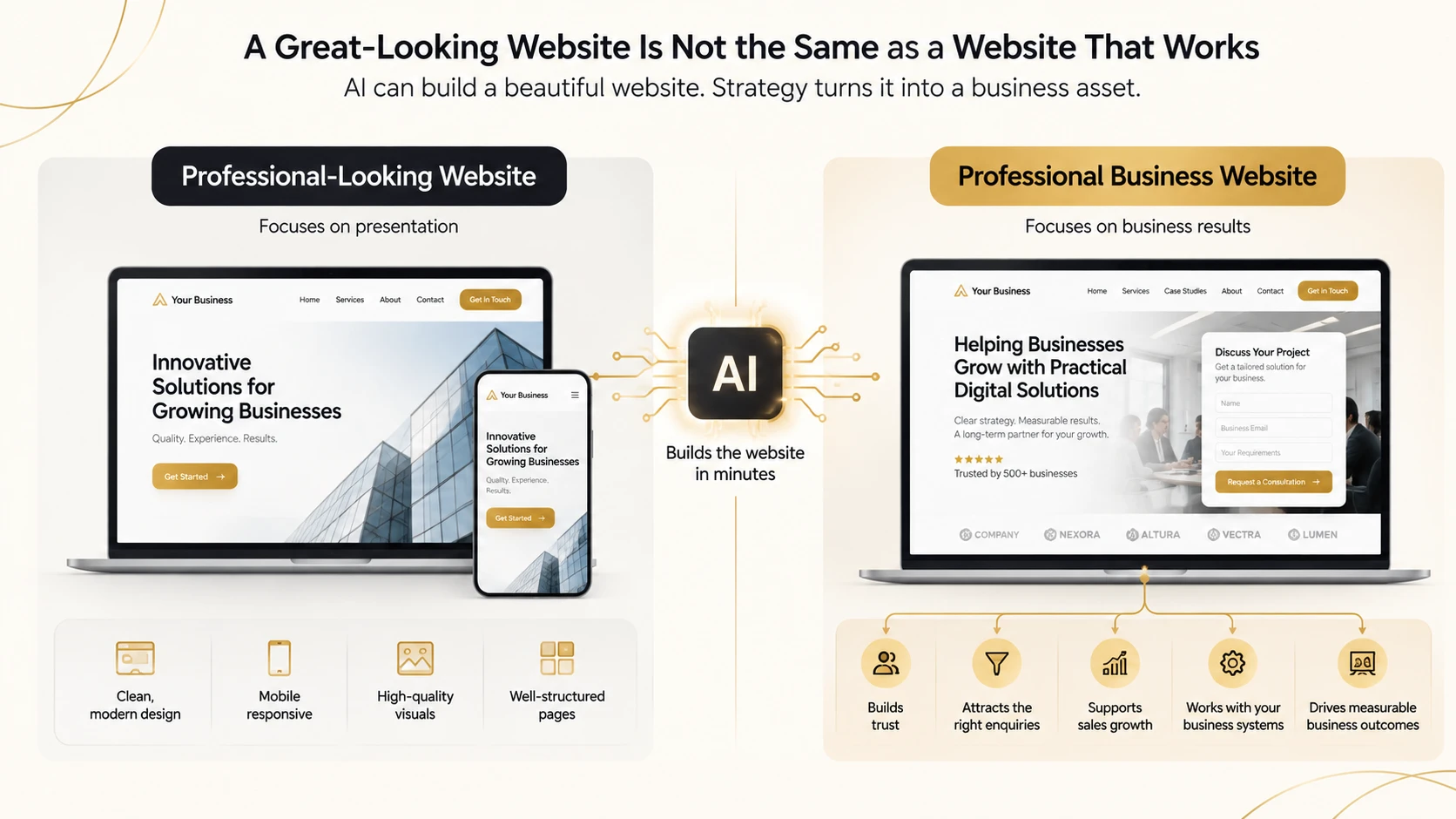
A professional-looking website focuses primarily on presentation:
- Does it look modern?
- Is the layout clean?
- Does it work well on mobile?
- Are the visuals consistent?
A professional business website has to go further:
- Does it communicate what the business does clearly?
- Does it build confidence with the right audience?
- Does it answer the questions potential customers have?
- Does it guide visitors toward the right next step?
- Does it support lead generation or sales?
- Does it fit into the wider way the business operates?
This distinction matters because AI can generate the visible parts of a website very quickly. What it cannot automatically determine is whether those elements are the right choices for a particular business.
For example, a beautifully designed service page may still fail if the messaging does not address the buyer’s actual concerns. A polished contact form may generate enquiries, but those enquiries may be poorly qualified. A complete website may contain every expected page while giving potential customers little reason to choose the business.
The goal, therefore, should not simply be to make an AI-built website look professional.
The goal is to make sure the website performs a professional business function.
That is where strategy becomes more important than appearance.
Where AI Can Build a Professional Business Website
AI is already capable of producing professional results in several important areas of website creation. For businesses with relatively straightforward requirements, it can handle much of the initial work without starting from a blank page.
Design and Layout
AI website builders can generate structured page layouts, responsive designs, typography, imagery, and consistent visual elements. With a clear brand direction and human review, these outputs can provide a strong professional foundation.
Website Content
AI can create first drafts of headlines, service descriptions, calls to action, FAQs, and other website content. This can significantly speed up content production, particularly when the business already has a clear understanding of its services and audience.
SEO Foundations
AI can also assist with basic SEO elements such as page titles, meta descriptions, headings, image alt text, and site structure. However, AI-generated content still needs to meet Google’s quality and people-first guidelines.
Conversion Elements
Forms, calls to action, service pages, and landing-page structures can also be generated with AI. For a straightforward business website, these elements may be sufficient to create a functional path from visitor to enquiry.
Speed of Development
Perhaps the biggest advantage is speed. AI can bring these components together much faster than traditional manual workflows, allowing a business to move from an idea to a functioning website quickly.
The important point is that AI is increasingly capable of producing the building blocks of a professional website. The challenge begins when those building blocks need to reflect deeper business requirements that AI cannot reliably determine on its own.
Where AI Alone Falls Short
AI can produce many of the components required for a business website. The limitation appears when those components need to reflect decisions that depend on the business itself.
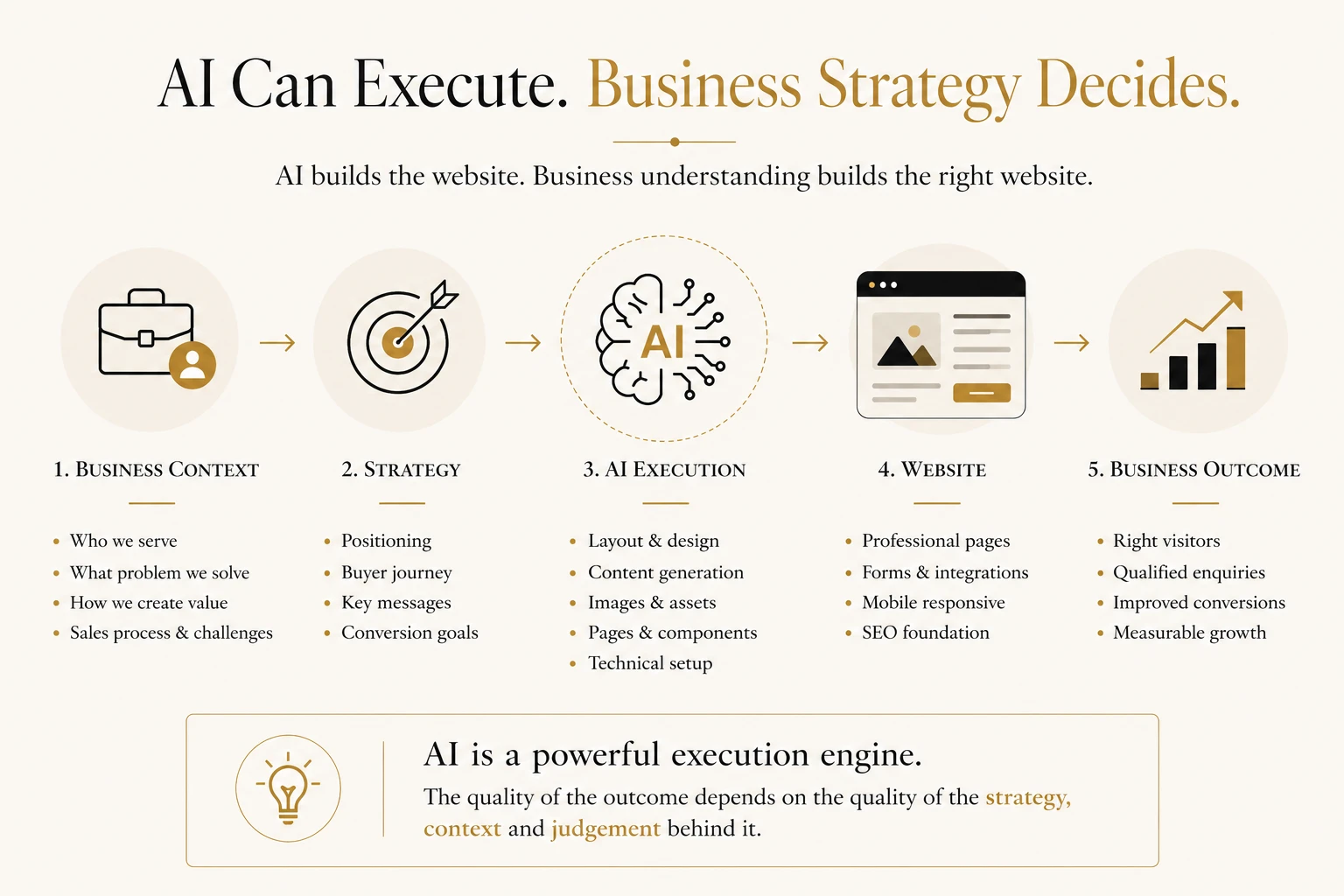
Understanding the Business
AI can work with the information you provide, but it does not automatically understand your competitive position, sales process, customer objections, or what makes your business different. Those inputs still need to come from the business.
Strategic Positioning
A website should make it immediately clear who the business serves, what problem it solves, and why a potential customer should consider it. AI can help communicate a strategy, but it cannot reliably determine the right positioning without the necessary business context.
Buyer Journey
Different customers need different information before they are ready to make a decision. AI can create pages and content, but understanding what a buyer needs to know, when they need to know it, and what should happen next requires a deeper understanding of the customer journey.
Complex Business Requirements
A simple website may not require much beyond pages, forms, and basic integrations. More complex businesses may need CRM connections, custom workflows, quoting systems, customer portals, ERP integrations, or other business-specific functionality. These requirements can move a project beyond what a typical AI website builder can handle on its own.
Ongoing Optimization
Launching a website is only the beginning. A business needs to understand whether the website is attracting the right visitors, generating useful enquiries, supporting sales, and contributing to business goals. AI can assist with analysis and improvement, but someone still needs to decide what should change and why.
The limitation, therefore, is not simply what AI can build. It is what AI can understand and decide without meaningful business direction.
So, Can AI Build a Professional Business Website?
Yes—but not simply because AI can generate one.
AI can build a professional business website when the requirements are clear, the business has a defined direction, and the generated website is properly reviewed and refined.
It can be a practical option when:
- The website has relatively straightforward requirements.
- The business already understands its audience and positioning.
- The required functionality is within the capabilities of the chosen AI tools.
- Content and design are reviewed for accuracy, relevance, and consistency.
- The website is evaluated against business goals rather than appearance alone.
The situation changes when the website needs complex functionality, custom workflows, deep integrations, or a highly specific buyer journey. In those cases, understanding the difference between an AI website builder and professional website development becomes important.
So the answer is not simply AI or humans.
For many businesses, the more useful approach is to determine which parts AI can handle effectively and where human expertise is needed to make the website work for the business.
AI Website Generation vs. AI Website Development
There is an important difference between generating a website with AI and using AI as part of a broader website development process.
AI website generation focuses on producing the website itself. You provide information about the business, and AI can generate layouts, content, images, pages, and other website components.
AI website development goes further. AI becomes part of a process that starts with understanding the business, defining the customer journey, planning the website structure, developing the required functionality, testing the experience, and measuring performance.
The first approach asks:
“Can AI create this website?”
The second asks:
“What should this website accomplish, and how can AI help us build it better?”
That distinction matters because a business website is ultimately a business asset, not simply a collection of AI-generated pages.
For a deeper look at how AI fits into the complete website development process, see our guide to AI Website Development.
What Makes an AI-Built Website Actually Work?
An AI-built website should not be judged by how quickly it was created or how polished it looks. A better test is whether it performs the job the business needs it to perform.
Ask five questions:
1. Does it attract the right audience?
The website should speak clearly to the people the business actually wants to reach, rather than trying to appeal to everyone.
2. Does it communicate value clearly?
Visitors should quickly understand what the business offers, who it helps, and why they should consider it. This aligns with Google’s emphasis on creating helpful, reliable, people-first content that provides genuine value to visitors.
3. Does it build trust?
Relevant evidence, clear information, credibility signals, and a professional experience can help potential customers feel confident about taking the next step.
4. Does it guide visitors toward action?
A good business website should make the next step obvious, whether that means requesting a quote, booking a consultation, making an enquiry, or contacting the business.
5. Can its performance be measured and improved?
A website should provide useful information about what is working and where visitors are dropping off, so the business can make informed improvements over time. This becomes increasingly important as search experiences evolve, including Google’s AI-powered search features.
These questions shift the focus from “Did AI build a good website?” to a more useful question:
“Is this website doing its job for the business?”
That is the standard an AI-built website should ultimately meet.
So, can AI build a professional business website that actually works?
Yes—but the quality of the result depends on more than the AI tool itself.
AI can dramatically speed up design, content creation, development, and other parts of the website process. But a website becomes a valuable business asset only when it reflects the right strategy, customer needs, positioning, and business goals.
The better question is not whether AI can build a website. It is whether the website helps the business achieve what it needs to achieve.
AI can accelerate website development. Business strategy determines what should be built and why.