
Introduction

AI-built websites need security designed into the digital system.
AI can now generate website layouts, write code, connect APIs, create content, and even help build complete business websites. But faster development does not automatically mean safer development.
A website can look professional, function correctly, and still contain security weaknesses. AI-generated code may introduce vulnerabilities, outdated dependencies, insecure configurations, or exposed credentials if it is not properly reviewed and tested. OWASP (Open Worldwide Application Security Project) specifically identifies risks such as hallucinated dependencies, vulnerable components, prompt injection, sensitive-code exposure, and insufficient human review in AI-assisted development.
The security challenge becomes even more important when a website uses AI features such as chatbots, document processing, customer data retrieval, or AI agents connected to other business systems. These integrations introduce additional attack surfaces that do not exist in a conventional website.
So, are AI-built websites secure?
The answer is: they can be—but security has to be deliberately designed, reviewed, and maintained. NIST similarly treats security and resilience as fundamental characteristics of trustworthy AI systems and emphasizes that AI systems inherit traditional software risks while introducing additional AI-specific risks.
This article looks at where those risks arise and what businesses should consider before trusting an AI-built or AI-powered website.
This article is part of our AI Website Development series. For the complete framework, read AI Website Development: The Complete Guide to Building Smarter, Faster & Better Websites with AI.
AI Website Security : Table of Contents
Is an AI-Built Website Secure?
An AI-built website can be secure, but the fact that AI generated the website does not provide any security guarantee. Security depends on the underlying architecture, the quality of the generated code, the technologies and dependencies used, the configuration of the website, and how thoroughly the result is reviewed and tested.
NIST specifically recommends that AI-generated software content be monitored and validated by humans, noting that uncritical acceptance of AI-generated code can allow insecure or non-functional code into the development process.
AI Does Not Automatically Make a Website Secure
AI coding tools can generate useful code quickly, but they can also produce code containing security weaknesses. Current OWASP guidance identifies risks including hallucinated dependencies, outdated vulnerable dependencies, prompt injection, sensitive-code exposure, and other risks associated with AI-assisted development.
This means the important question is not:
“Was the website built using AI?”
The better question is:
“Was the AI-generated website properly designed, reviewed, tested, and secured?”
AI should be treated as a development capability—not as a security control.
Security Depends on How the Website Is Built
AI coding tools can generate useful code quickly, but they can also produce code containing security weaknesses. Current OWASP guidance identifies risks including hallucinated dependencies, outdated vulnerable dependencies, prompt injection, sensitive-code exposure, and other risks associated with AI-assisted development.
This means the important question is not:
“Was the website built using AI?”
The better question is:
“Was the AI-generated website properly designed, reviewed, tested, and secured?”
AI should be treated as a development capability—not as a security control.
Security Depends on How the Website Is Built
Two websites can both be described as AI-built websites while having very different security profiles.
A simple marketing website with static pages has a relatively limited attack surface. A website connected to customer accounts, databases, payment systems, APIs, or an AI chatbot has considerably more components that need to be secured.
The security of an AI-built website ultimately depends on how the resulting system is designed, implemented, reviewed, and maintained. AI can accelerate development, but it does not remove the need for secure architecture, testing, and human oversight.
This is why simply asking whether AI can build a secure website is the wrong level of analysis. The real issue is how the resulting digital system is designed and governed.
Where AI-Built Websites Can Become Vulnerable
AI can accelerate development, but the code it produces still needs to be treated like software written by any other developer: it must be reviewed, tested, and maintained.
AI-generated code should be treated like any other production code: it needs to be reviewed, tested, and maintained. Security weaknesses can appear in the code itself, its dependencies, authentication, input handling, or the way it connects to external services.
Vulnerabilities in AI-Generated Code
AI coding tools can generate code that appears correct while containing security weaknesses. For example, generated code may implement authentication incorrectly, fail to validate user input, expose sensitive information, or use an insecure method of accessing a database or API.
The problem is not necessarily that AI is incapable of writing secure code. The problem is that working code is not the same as secure code.
Without proper code review and security testing, vulnerabilities can make their way into production without being obvious from the website’s appearance or normal functionality.
Insecure Authentication and Access Controls
A website may need to distinguish between different types of users—customers, employees, administrators, or external partners.
If authentication or authorization is implemented incorrectly, an attacker may gain access to information or functionality they should not have.
For AI-built websites, developers should verify not only whether users can log in, but also what each authenticated user is actually allowed to access or change.
Injection and Input Validation Problems
Websites frequently receive data from users through forms, search fields, URLs, file uploads, APIs, and other inputs.
That data should never automatically be trusted.
If AI-generated code fails to properly validate, sanitize, or handle input, it can create opportunities for attacks such as injection or malicious script execution.
This is one reason generated code should be tested against unexpected and potentially malicious input—not just normal user scenarios.
Vulnerable or Outdated Dependencies
AI tools may recommend libraries, packages, frameworks, or code examples to complete a task. Those dependencies can themselves contain vulnerabilities or may become outdated over time.
There is also a specific AI-related risk known as package hallucination, where an AI model suggests a package that does not exist or recommends an incorrect dependency. OWASP identifies this as a software supply-chain risk because attackers can potentially register malicious packages using names suggested by AI systems.
For this reason, every dependency used by an AI-built website should be verified, maintained, and updated.
Exposed API Keys and Secrets
AI-powered websites often connect to external services through APIs. These may include AI models, payment platforms, CRMs, analytics systems, or other business applications.
A common mistake is placing API keys or other credentials somewhere they can be exposed to website visitors or included in publicly accessible code.
If an attacker obtains such credentials, they may be able to use the connected service without authorization.
AI can generate the integration code, but protecting the credentials remains a development and security responsibility.
New Security Risks in AI-Powered Websites
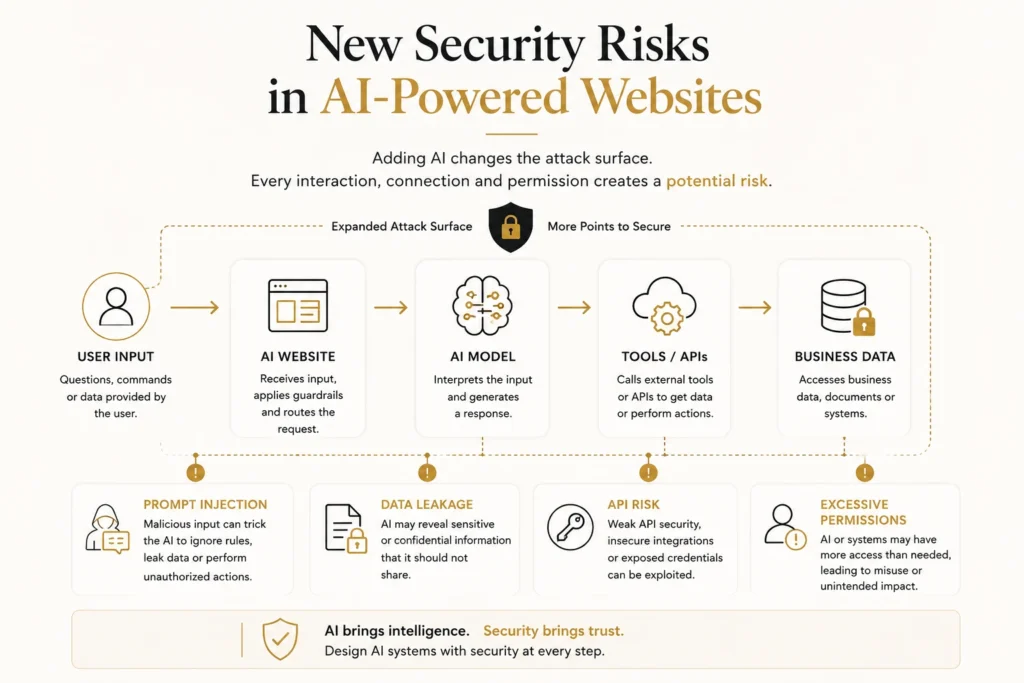
Adding AI to a website changes more than its functionality. It can introduce a new layer between the visitor and the underlying business systems.
When AI is added to a website, the security surface can expand. The system may need to process natural-language instructions, retrieve information, call external tools, and interact with business systems. Each of these interactions introduces additional security considerations.
Prompt Injection
Prompt injection occurs when specially crafted input influences an AI system to behave in ways the application was not designed to allow. NIST defines it as an attack that exploits the combination of untrusted input with instructions created by the application.
For example, a business website may have an AI assistant that can search company documents and answer customer questions. A malicious user could attempt to manipulate the assistant into ignoring its intended instructions or revealing information it should not provide.
The risk becomes more serious when the AI is connected to private information or actions. OWASP notes that successful prompt injection can potentially lead to sensitive-information disclosure, unauthorized function access, or actions in connected systems.
AI Data Leakage
AI-powered websites may process information that businesses consider confidential, including customer details, uploaded documents, internal knowledge, product information, or conversations.
If data access and output controls are poorly designed, an AI system may expose information to someone who should not have access to it. OWASP identifies sensitive information disclosure as a major LLM application risk, covering personal information, financial data, confidential business information, credentials, and other sensitive material.
The important question is therefore not simply “Is the AI secure?”
It is:
What information can the AI access, and who can it reveal that information to?
AI Agents and Excessive Permissions
The security risk increases significantly when an AI system can take actions, rather than simply generate answers.
An AI agent might be connected to a CRM, email system, database, document repository, or other business application. If it receives excessive permissions, an unexpected or manipulated AI response could result in actions beyond what the system actually needs to perform.
OWASP classifies this as Excessive Agency, driven by excessive functionality, excessive permissions, or excessive autonomy.
For example, if an AI assistant only needs to read customer information, it should not automatically have permission to modify or delete that information.
Third-Party AI APIs and Integrations
Many AI-powered websites depend on external AI services through APIs.
This creates another layer of dependency:
Website → API → AI service → Data → Response
Security therefore depends not only on the website itself, but also on how these integrations are authenticated, what information they receive, what they are permitted to access, and how their responses are handled.
A secure AI website should treat every external integration as part of its security architecture—not as simply another feature to connect.
The Website Is Only One Part of the Security Problem
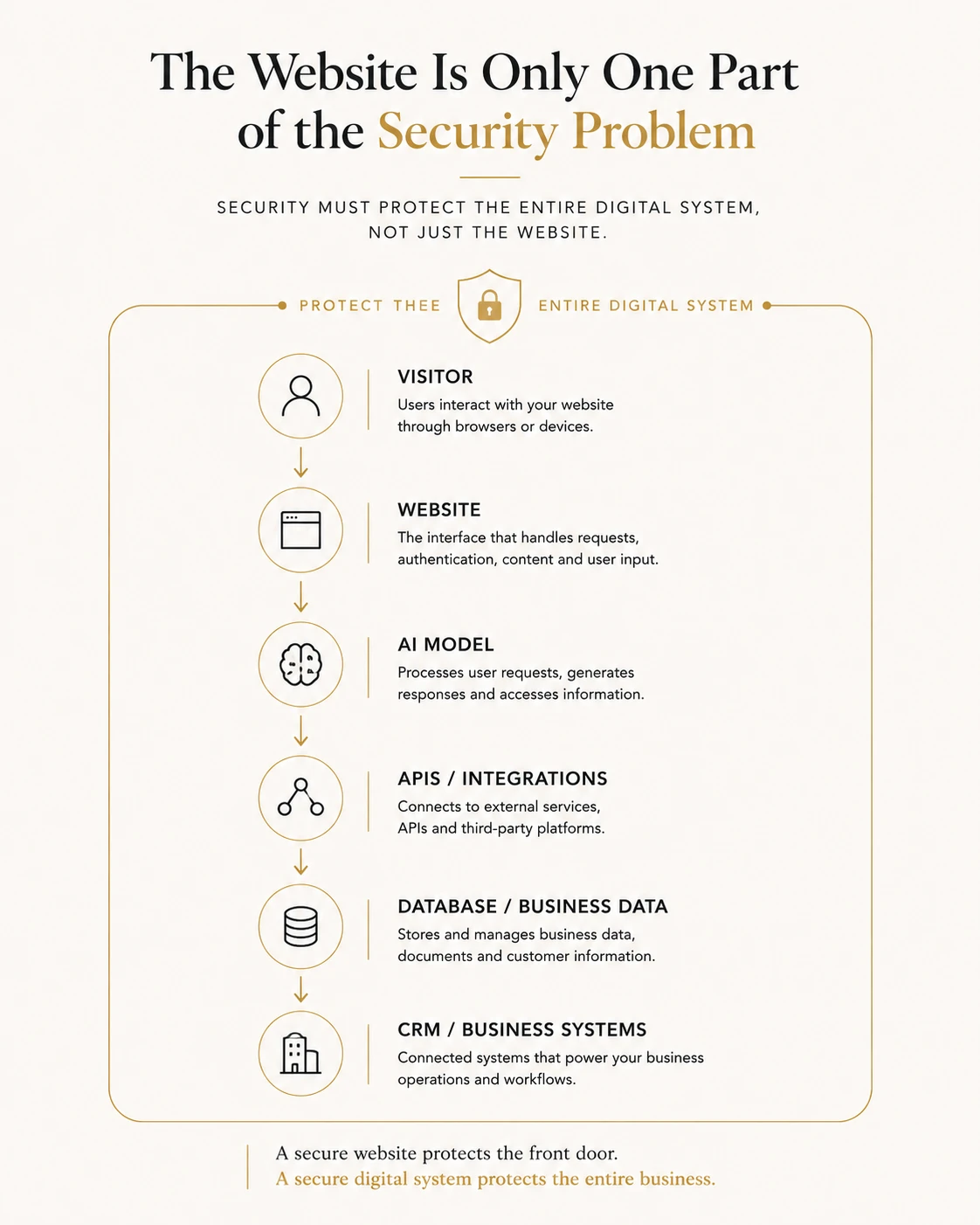
Website security is often treated as a problem limited to the website itself. But once AI is connected to APIs, databases, customer information, or other business applications, the security boundary becomes much larger.
An AI-powered website can be more complex.
It may connect the website to an AI model, external APIs, databases, customer information, documents, CRM systems, or other business applications. This means a security weakness in one component can potentially affect other parts of the system.
The right question is therefore not simply:
“Is my website secure?”
It is:
“Is the entire digital system connected to my website secure?”
The Website
The website is the interface visitors interact with. It handles user input, authentication, forms, files, and requests to other services.
A vulnerability here can provide an entry point into the wider system.
The AI Model
The AI model introduces a different type of interaction because users communicate with it using natural language.
The system must control what the AI is instructed to do, what information it can access, and what it is allowed to return.
APIs and Integrations
APIs connect the website and AI functionality to external services.
Each API introduces credentials, data transfers, permissions, and another dependency that needs to be secured.
Databases and Business Data
AI features may need access to customer records, product information, internal documents, or other business data.
Access should be limited to exactly what the AI functionality requires. An AI assistant that answers product questions, for example, may not need access to customer financial records.
Connected Business Systems
The most significant risk can arise when AI is connected to systems beyond the website.
A website might eventually connect to:
Website → AI → API → CRM → Customer Data
or:
Website → AI → Documents → Internal Business Information
At this point, website security becomes digital-system security.
A business should therefore evaluate security across the entire chain rather than treating the website and AI functionality as separate components. This systems-level approach becomes increasingly important as AI moves from simply answering questions to accessing information and performing actions.
How to Secure an AI-Powered Website
Securing an AI-powered website requires more than protecting the website itself. The AI model, APIs, databases, integrations, and connected business systems all need appropriate security controls.
The goal is to reduce unnecessary exposure, limit the impact of a security incident, and ensure that every component has only the access it actually needs.lly needs.
Review AI-Generated Code
AI-generated code should be treated as code that requires review—not as code that is automatically secure.
A qualified developer should review important parts of the implementation, particularly authentication, authorization, input handling, database queries, API integrations, and security-sensitive functionality.
NIST’s secure software development guidance does not distinguish between human-written and AI-generated source code when evaluating vulnerabilities: all source code should be evaluated before use.
Human review is especially important when AI coding tools make changes across multiple files, install dependencies, or interact with development and deployment systems.
Protect API Keys and Secrets
API keys, passwords, tokens, database credentials, and other secrets should never be exposed in publicly accessible website code.
AI-powered websites often depend on multiple external services, making credential management particularly important. Credentials should be stored securely and access should be restricted to the systems that actually require them.
It is also important to understand what information AI development tools themselves can access. Some AI coding tools may process project files or other context when generating code, so sensitive files and credentials should be excluded from their context where appropriate.
Apply Least-Privilege Access
An AI system should have only the permissions required for its intended function.
If an AI assistant only needs to read product information, it should not have permission to modify customer records. If it needs to retrieve information from a database, it may not need permission to delete or change that information.
This principle is particularly important for AI agents that can use tools or perform actions. OWASP recommends limiting agents to the minimum tools and permissions required for their specific task.
The less an AI system can access or change, the smaller the potential impact if something goes wrong.
Validate and Sanitize User Input
User input should be treated as untrusted data.
This applies to traditional website forms and APIs, but it becomes especially important when user input is passed into an AI system or used to trigger actions.
Input should be validated before it is processed, and AI applications should establish clear boundaries between user-provided content and system instructions. OWASP recommends validating untrusted input and applying appropriate controls before that information enters an application workflow.
For AI-powered websites, this is one of the important controls for reducing the impact of prompt injection and other input-based attacks.
Secure AI Integrations
Every external AI service, API, plugin, tool, or business-system integration adds another dependency to the digital system.
Before connecting an AI feature, determine:
- What information is being sent?
- What information can be retrieved?
- What actions can the integration perform?
- How is access authenticated?
- What happens if the external service is compromised or unavailable?
Integrations should be limited to what the website actually needs, with appropriate authentication, permissions, validation, and monitoring.
Keep Dependencies Updated
AI-generated applications may depend on libraries and packages that can become outdated or contain known vulnerabilities.
AI coding tools can also suggest packages that are outdated or, in some cases, packages that do not actually exist. OWASP specifically recommends verifying AI-suggested dependencies and checking them for known vulnerabilities rather than installing them blindly.
Dependency management should therefore remain part of the normal maintenance process, regardless of whether the original code was written by a developer, generated by AI, or produced through a combination of both.
Monitor and Test the System
Security is not a one-time activity completed when the website goes live.
AI models, prompts, APIs, dependencies, integrations, and business requirements can all change over time. New vulnerabilities can also emerge after deployment.
Regular security testing, dependency checks, logging, monitoring, and review help identify problems before they become larger incidents.
For AI-powered systems, testing should also consider AI-specific behaviours such as prompt injection, unintended data disclosure, excessive permissions, and unexpected tool usage. OWASP recommends adversarial testing and monitoring for AI systems, particularly when prompts, tools, memory, retrieval systems, or providers change.
A secure AI website is therefore not simply built securely. It is maintained as a secure system over time.
How Business Owners Should Evaluate AI Website Security
Business owners do not need to become cybersecurity experts to evaluate whether an AI-powered website is being built responsibly. They first need to understand how AI website development works and what role AI plays in the overall website system.
What they do need is a clear understanding of what the system can access, where business data moves, what happens when something goes wrong, and who is responsible for managing the risk.
Before launching an AI-powered website, ask the following questions.
Where Does Customer Data Go?
Understand what information the website collects and where that information is processed or stored.
If an AI feature receives customer enquiries, uploaded documents, personal information, or other business data, determine which services process that information and what happens to it afterward.
The more sensitive the data, the more carefully its flow through the system should be evaluated.
What Can the AI Access?
An AI feature should not automatically have access to everything available within the business.
Ask exactly what the AI can:
- Read
- Retrieve
- Modify
- Delete
- Send
- Trigger
Access should be limited to what the AI actually needs to perform its intended function.
What Happens If the AI Is Manipulated?
AI systems can receive unexpected or deliberately crafted instructions.
Ask how the system responds if someone attempts to manipulate the AI, extract restricted information, bypass its instructions, or make it perform an unauthorized action.
Security should not depend on assuming that every user will interact with the AI honestly.
Who Is Responsible for Security?
AI may generate significant portions of the website or its functionality, but responsibility cannot simply be passed to the AI tool.
There should be a clear owner for:
- Security review
- Updates
- Vulnerability management
- Access control
- Monitoring
- Incident response
Knowing who is responsible when something goes wrong is just as important as knowing which technology was used to build the website.
What Happens When an AI Service Fails?
An AI-powered website may depend on external AI models, APIs, or other services.
Consider what happens if one of these services becomes unavailable, changes its API, reaches a usage limit, or produces an unexpected response.
A well-designed system should have appropriate failure handling so that a temporary AI problem does not unnecessarily bring down the entire website or disrupt critical business processes.
The goal is not to eliminate every possible risk. It is to understand the system well enough to make informed decisions about what risks are acceptable, what controls are required, and what should happen when something fails.
Can AI Secure an AI-Built Website?
AI can play a useful role in website security. It can help identify suspicious activity, review code, analyze logs, detect unusual patterns, and assist security teams in finding vulnerabilities.
But there is an important distinction between using AI to improve security and expecting AI to secure the entire website by itself.
AI is another component of the security strategy—not a replacement for security engineering, architecture, testing, and human accountability.
Where AI Can Help With Security
AI can assist security teams with tasks that would otherwise require significant manual effort.
For example, AI-assisted security tools can help review large amounts of source code, identify potential vulnerabilities, analyze security events, and detect patterns that may deserve further investigation.
AI can also assist with security testing by generating test cases, identifying unusual inputs, and helping developers investigate potential weaknesses.
However, these capabilities should be treated as security assistance, rather than proof that a system is secure. Current OWASP guidance recommends human review of AI-generated code and warns against treating AI-generated tests or AI-based review as independent assurance.
Why AI Cannot Replace Security Engineering
Security decisions often depend on business context.
An AI tool may identify a technical vulnerability, but determining its actual business impact can require understanding the application’s architecture, users, data, permissions, and operational processes.
The same applies when an AI system itself is given access to business systems. OWASP recommends least-privilege access, human approval for high-risk actions, and adversarial testing for AI agents rather than relying solely on the model’s output.
Ultimately, someone must remain accountable for deciding:
- What the AI is allowed to access
- Which actions require approval
- What data needs protection
- What risks are acceptable
- How the system should respond when something goes wrong
AI can help detect and reduce security risks. It should not be the entity responsible for deciding whether those risks are acceptable.
For a business, the safest approach is therefore not AI instead of security engineering, but:
AI-assisted security + sound architecture + appropriate controls + human oversight.
AI Website Security Checklist for Business Owners
Before launching an AI-built or AI-powered website, businesses should verify that:
- AI-generated code has been reviewed and tested.
- API keys, passwords, and other secrets are properly protected.
- Users and AI systems have only the permissions they actually need.
- User input is properly validated and handled.
- AI integrations and external APIs are securely configured.
- Third-party dependencies are verified and kept updated.
- Sensitive business and customer data is appropriately protected.
- AI systems are tested for prompt injection and unintended data disclosure.
- Important AI actions have appropriate controls or human approval.
- Security logs, monitoring, and alerts are in place.
- There is a process for responding to vulnerabilities and security incidents.
- Regular backups and recovery procedures are available.
- Someone is clearly responsible for ongoing security and maintenance.
A website should not be considered secure simply because it was successfully built and launched. Security is an ongoing process that needs to continue as the website, AI models, integrations, dependencies, and business requirements change.
Frequently Asked Questions
Are AI-Built Websites Secure?
AI-built websites can be secure, but AI itself does not guarantee security. Security depends on the website’s architecture, generated code, dependencies, integrations, access controls, testing, and ongoing maintenance.
Can AI-Generated Code Be Vulnerable?
Yes. AI-generated code can contain vulnerabilities such as insecure authentication, improper input validation, vulnerable dependencies, or insecure API implementations. AI-generated code should therefore be reviewed and tested before being used in production.
How Do You Secure an AI-Built Website?
Start by reviewing the generated code, protecting credentials and API keys, applying least-privilege access, validating user input, securing AI integrations, keeping dependencies updated, and continuously monitoring and testing the system.
What Is Prompt Injection?
Prompt injection is an attack in which specially crafted input attempts to manipulate an AI system into ignoring its intended instructions or performing unintended actions. The risk becomes more significant when an AI system can access sensitive information or connected business systems.
Are AI Website Builders Safe for Businesses?
They can be, provided the platform offers appropriate security controls and the resulting website is properly configured and maintained. Businesses should evaluate how the platform handles data, authentication, integrations, updates, and security rather than assuming that using an established AI platform automatically makes a website secure.
Can AI Websites Access Customer Data?
Yes, if they are specifically designed and authorized to access it. For example, an AI assistant may be connected to a CRM, database, or knowledge base. Such access should be limited to the information the AI actually needs, with appropriate authentication, permissions, and data-protection controls.
Conclusion: AI Can Build the Website. Security Still Needs to Be Designed.
AI can make website development faster, but speed should never be confused with security.
An AI-built website can be secure when its code is reviewed, its dependencies are managed, its integrations are controlled, and its data and permissions are properly protected. The challenge becomes greater when AI is connected to customer information, APIs, databases, or other business systems.
That is why AI website security should be considered at the system level—not simply at the website level.
If you are considering AI for your next website, understanding the broader AI website development process is an important first step. The technology you use matters, but how that technology is designed, secured, implemented, and maintained matters even more.
AI can build the website. Security still needs to be designed.
Ready to Build a Smarter Website?
Whether you’re exploring AI website builders or need a custom website that combines the power of AI with professional design, development, and SEO, choosing the right strategy is more important than choosing the latest tool.
If you’d like expert guidance on selecting the best approach for your business, we’re here to help.
Explore our services:
Or contact us to discuss your website project and discover how AI and human expertise can work together to build a website that supports your long-term business goals.