
Is Hostinger Actually Good?

Short answer: Hostinger is a strong option for small and growing business websites, particularly when you want a balance of affordability, ease of use, and managed hosting. But it isn’t the right choice for every business.
Hostinger has moved well beyond being a basic low-cost hosting provider. Its current offering spans managed web hosting, WordPress hosting, cloud hosting, VPS, website building, AI tools, and business-oriented infrastructure. Its hosting plans also include features such as SSL, backups, CDN, website migration, and 24/7 support, depending on the plan.
For a typical business website, service business, consultant, B2B company, or small-to-medium website, that combination makes Hostinger worth considering.
However, the cheapest advertised price should not be the reason you choose it.
The more important questions are:
- How does it perform under real-world conditions?
- What will you actually pay after the introductory period?
- How reliable is it?
- How good is the support when something goes wrong?
- Which plan does a business actually need?
- What happens when the website starts growing?
- Is Hostinger still the right choice when your requirements become more demanding?
That’s what this review focuses on.
Table of Contents
Where Hostinger stands out
Hostinger’s biggest advantage is the combination of price, simplicity, and breadth of features. Its current plans are designed to let users start with relatively simple hosting and move toward more powerful cloud infrastructure as their requirements increase. The company currently positions its Business and Cloud plans for growing websites, while VPS provides more control for users with advanced technical requirements.
For a business owner who doesn’t want to manage server infrastructure, this can be valuable. You can run WordPress, manage domains and email, use backups and CDN features, and handle many routine hosting tasks through Hostinger’s hPanel rather than dealing directly with server administration.
Where you need to be careful
The headline pricing can make Hostinger look cheaper than the long-term cost actually is. Current plans are sold with different introductory and renewal rates, and the lowest advertised monthly price is based on a long-term upfront commitment. For example, Hostinger currently lists its Premium plan at ₹149/month for a 48-month term, with renewal at ₹449/month.
That doesn’t necessarily make Hostinger poor value. It simply means the introductory price isn’t enough information to make a hosting decision.
There’s also a significant difference between a small brochure-style business website and a high-traffic ecommerce store or application. Hostinger provides cloud and VPS options for businesses that need more resources and control, but that doesn’t mean every growing website should automatically stay with Hostinger forever.
Our approach to Hostinger review
Rather than judging Hostinger purely by its feature list, we’ll evaluate it from a business owner’s perspective.
We’ll look at its:
Pricing → Performance → Reliability → Ease of use → Security → Support → Scalability → Business suitability
The goal isn’t to prove that Hostinger is the best hosting provider.
It’s to determine where Hostinger makes sense, where it doesn’t, and which type of business should consider using it.
Our preliminary verdict: Hostinger is worth considering for most small and moderately growing business websites, but the right plan—and the long-term cost—matter considerably more than the advertised entry price.
Hostinger Pricing: What Will You Actually Pay?
Hostinger is often promoted around its low monthly starting price, but the advertised monthly figure is not the same as your actual hosting cost. The important numbers are the total amount you pay upfront, how long that introductory price applies, and what the plan costs when it renews.
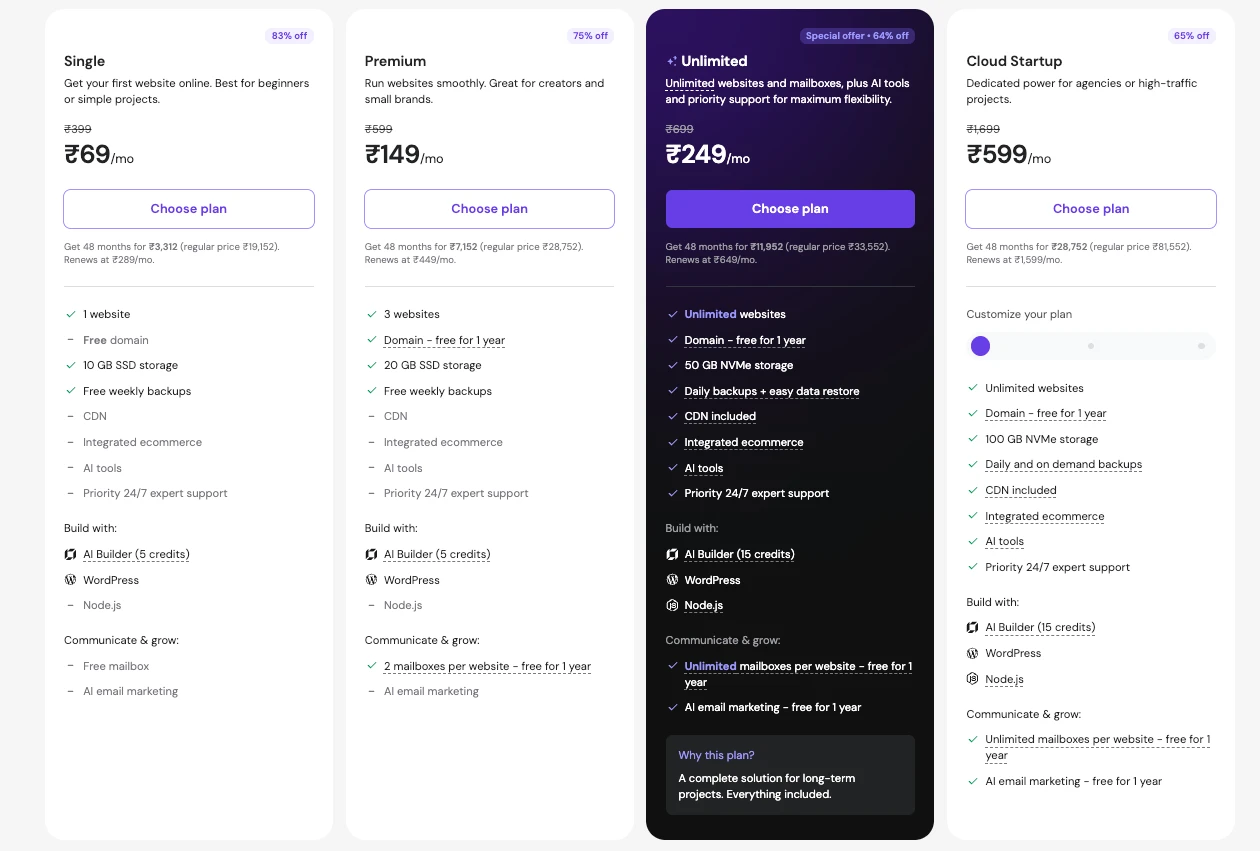
At the time of writing, Hostinger’s Indian website lists its main web-hosting plans on a 48-month term. For example, Premium is advertised at ₹149/month, but that means paying ₹7,152 upfront for 48 months. The plan currently renews at ₹449/month. Unlimited is ₹249/month on the introductory term, requiring ₹11,952 upfront, and renews at ₹649/month. Cloud Startup is ₹599/month, or ₹28,752 upfront for 48 months, and renews at ₹1,599/month.
| Plan | Introductory price | Upfront payment | Renewal price |
|---|---|---|---|
| Single | ₹69/mo | ₹3,312 / 48 months | ₹289/mo |
| Premium | ₹149/mo | ₹7,152 / 48 months | ₹449/mo |
| Unlimited | ₹249/mo | ₹11,952 / 48 months | ₹649/mo |
| Cloud Startup | ₹599/mo | ₹28,752 / 48 months | ₹1,599/mo |
Prices shown are based on Hostinger’s current India pricing and can change. Always verify the current checkout price before purchasing.
The introductory price can be misleading
This doesn’t mean Hostinger is overpriced. In fact, the introductory pricing can represent good value if you are comfortable making a longer-term commitment.
The problem is that comparing hosting providers using only their advertised “₹X/month” price can give you the wrong impression.
For example, Premium works out to ₹149/month during the initial 48-month term, but its current renewal price is ₹449/month. At renewal, the monthly cost is therefore roughly three times the introductory rate.
That’s why we recommend looking at total cost of ownership, rather than simply choosing the provider with the lowest promotional price.
What do you actually get for the money?
The value depends heavily on the plan.
The Premium plan currently supports up to three websites and includes 20 GB SSD storage, weekly backups, CDN, a free domain for one year, and email accounts for the first year. Unlimited increases the capacity to unlimited websites, 50 GB NVMe storage and daily backups, while also adding features such as ecommerce tools and additional AI capabilities.
Cloud Startup moves into a different category. It currently includes 4 CPU cores, 4 GB RAM, 100 GB NVMe storage, daily and on-demand backups, a dedicated IP and priority support, making it more appropriate for websites that need greater resources and scalability.
So the question isn’t simply:
“Is Hostinger cheap?”
It’s:
“Which Hostinger plan gives my business enough resources without paying for infrastructure I don’t need?”
Don’t forget the renewal cost
This is probably the single most important pricing consideration for a business.
If you’re building a website that you expect to keep for five or ten years, the promotional period is only part of the financial picture. You should consider:
Initial hosting cost → renewal cost → domain renewal → additional services → potential plan upgrades
Hostinger does include a free domain for the first year on qualifying plans, but that benefit does not mean the domain remains free indefinitely. Similarly, some email benefits are limited to the first year depending on the plan.
This is particularly important for businesses because switching hosting providers every few years simply to chase introductory pricing isn’t always worth the operational disruption.
Is Hostinger good value?
Yes, but mainly when you choose the plan based on your actual requirements.
For a small business website with moderate traffic, Premium or Unlimited can offer a substantial amount of infrastructure for the initial price. A business expecting higher traffic, more demanding WordPress workloads or ecommerce activity may get better value from Cloud hosting rather than trying to stretch a lower-tier shared plan beyond its intended use.
Hostinger also offers a 30-day money-back guarantee for eligible web-hosting purchases, although domains and some other products have different refund conditions.
Our pricing verdict
Hostinger’s promotional pricing is genuinely competitive, but the renewal price is the number you should pay the most attention to.
For a business owner, I’d evaluate Hostinger on its long-term cost relative to the resources and reliability you actually need, rather than selecting it simply because the headline price looks cheap.
We’ll come back to this when we compare the individual plans and determine which Hostinger plan makes sense for different types of businesses.
Hostinger Plans Compared: Which One Should You Choose?
Hostinger currently offers several web hosting tiers, but most business website owners do not need to consider every product in its portfolio. For a typical website, the practical decision is between Premium, Unlimited, and Cloud Startup. Hostinger also offers a Single plan for very basic websites, while VPS and other products are intended for more specialised requirements.
The right choice depends less on the number of features included and more on how demanding your website is today and how much room you need to grow.
Hostinger’s main web hosting plans
| Plan | Best suited for | Websites | Storage | CPU / RAM | Our view |
|---|---|---|---|---|---|
| Single | Basic/personal websites | 1 | 10 GB SSD | 1 CPU / 1 GB RAM | For very simple projects |
| Premium | Small business websites | 3 | 20 GB SSD | 1 CPU / 2 GB RAM | Good starting point |
| Unlimited | Growing businesses & multiple websites | Unlimited | 50 GB NVMe | 2 CPU / 3 GB RAM | Best overall value for many businesses |
| Cloud Startup | High-traffic & resource-demanding sites | Unlimited | 100 GB NVMe | 4 CPU / 4 GB RAM | Best for businesses expecting growth |
Hostinger’s current India pricing page lists these four web-hosting tiers and shows significant differences in storage, CPU, RAM, PHP workers, databases, backups and other resources as you move up the plans.
Single: Only for very basic websites
The Single plan is designed to get one basic website online at the lowest entry price. It currently includes one website, 10 GB SSD storage, one CPU core and 1 GB RAM.
For a serious business website, however, I would generally skip this plan.
The small price difference between the entry-level plan and Premium can be less important than having enough resources and flexibility for a business website that you expect to maintain for several years.
Best for: simple personal websites, basic projects and very small sites.
Our recommendation: Not our first choice for a business website.
Premium: A sensible starting point for a small business
Premium is where Hostinger becomes much more interesting for businesses.
The current plan supports up to three websites, provides 20 GB SSD storage, 2 GB RAM and 1 CPU core, along with features such as CDN, weekly backups, SSL and WordPress support.
For a typical:
- Local business website
- Consultant or professional website
- Small B2B company
- Service business
- Basic company website
Premium can be enough.
However, I would not choose it simply because it is the cheapest plan that looks capable. If the website is strategically important to the business, having more resources and better backup capabilities may justify moving up one tier.
Best for: small, relatively simple business websites with moderate traffic.
Our recommendation: Good starting point for a small business.
Unlimited: The practical choice for many growing businesses
The Unlimited plan is where the value proposition becomes stronger for businesses.
It currently supports unlimited websites, provides 50 GB NVMe storage, daily backups, CDN, ecommerce functionality and additional AI tools. It also provides more CPU and RAM than Premium.
The important difference isn’t simply the word “Unlimited.”
The additional server resources and daily backups are arguably more relevant to a business than the ability to host an unlimited number of websites.
For example, if you’re managing:
- A company website
- A separate landing-page website
- A campaign website
- A second business website
- Multiple small projects
the additional capacity can make Unlimited more practical.
Best for: growing businesses, multiple websites, ecommerce projects and businesses that want more room than Premium provides.
Our recommendation: The plan I’d consider first for many established small businesses.
Cloud Startup: When performance and scalability matter more
Cloud Startup is a different proposition.
The current plan provides 100 GB NVMe storage, 4 CPU cores, 4 GB RAM, 100 PHP workers, daily and on-demand backups, a dedicated IP and priority support.
That makes it more appropriate for websites where performance and resource availability matter more than simply keeping hosting costs low.
Examples include:
- High-traffic WordPress websites
- Growing ecommerce stores
- Larger business websites
- Websites experiencing traffic spikes
- Agencies managing multiple demanding sites
- Websites that have outgrown shared hosting
You shouldn’t automatically move to Cloud Startup just because it is more powerful. If your website receives modest traffic and has a straightforward workload, you may simply be paying for resources you don’t need.
Best for: growing or resource-intensive websites.
Our recommendation: Choose it when your website actually needs the additional resources or you expect meaningful growth.
What About VPS Hosting?
Hostinger also offers VPS hosting, but I would not put it in the same decision category as the plans above.
The fundamental difference is control.
VPS hosting is aimed at users who need root access and greater control over the server environment. That makes it more suitable for developers, custom applications and technically demanding projects rather than the average business website.
For a normal WordPress business website, I would generally prefer a managed hosting environment until there is a specific technical reason to move to a VPS.
Which Hostinger Plan Would We Choose?
Our recommendation would be:
Simple personal website → Single
Small business website → Premium
Established business or multiple websites → Unlimited
Growing/high-traffic business website → Cloud Startup
Custom application or advanced server requirements → VPS
The key principle is:
Don’t buy the most powerful hosting plan you can afford. Buy the level of infrastructure your website actually needs—with enough headroom for reasonable growth.
For most business owners, Premium and Unlimited are the plans worth comparing first. Cloud Startup becomes more compelling when performance, traffic, ecommerce activity or resource requirements justify the additional cost.
Hostinger itself recommends moving from web hosting toward Cloud when a project needs more resources, and toward VPS when advanced server control becomes necessary.
Our preliminary recommendation: If you’re launching a straightforward business website, start with Premium. If the website is important to your business, you expect multiple websites, ecommerce, or stronger growth, Unlimited is likely the more sensible starting point. We would consider Cloud Startup when the website’s traffic or workload justifies it.
Our Hostinger Testing Methodology
This isn’t a review based solely on Hostinger’s specifications or a short trial. I’ve been using Hostinger for several years, including for real websites and day-to-day hosting requirements.
That long-term experience gives this review a different perspective. Instead of asking only whether Hostinger looks good on paper, I can evaluate how the platform performs as a hosting environment over time.
For this review, I combine my long-term experience with Hostinger with current checks of its pricing, features, performance, usability, support, and business suitability.
What We Evaluate
Long-term experience
How the platform has performed over years of use, including website management, hosting administration, updates, backups, and general reliability.
Performance
Website speed, server response time, Core Web Vitals and overall performance under realistic website conditions.
Reliability
Availability, uptime and any reliability issues experienced during long-term use.
Ease of use
The practical experience of managing websites through hPanel, including WordPress, domains, SSL, backups and other routine tasks.
Customer support
The quality and usefulness of Hostinger’s support when dealing with technical or account-related issues.
Business suitability
Whether Hostinger provides the performance, resources, security and scalability that a business website actually needs.
Why Long-Term Experience Matters
A hosting provider can look impressive during a short trial. The more important question is what happens after you’ve used it for years.
Over a longer period, you get to see things that a short-term test may miss:
- How easy the platform remains to manage
- How pricing changes over time
- How upgrades and renewals work
- How the hosting performs as websites evolve
- How backups and migrations work in practice
- How support handles real problems
- Whether the platform continues to make sense as business requirements change
This doesn’t mean my experience represents every Hostinger customer. Hosting performance can vary depending on the website, server location, traffic, configuration and plan.
That’s why we combine long-term practical experience with measurable testing and current product information wherever possible.
Our Review Approach
The review therefore combines three types of evidence:
1. First-hand experience
My experience using Hostinger over several years.
2. Current testing
Performance, usability and other measurable checks conducted for this review.
3. Independent and official information
Current Hostinger documentation, pricing and relevant independent evidence.
This distinction matters.
We separate what Hostinger says, what we measure, and what we’ve experienced ourselves.
That is the basis for the assessment that follows.
Hostinger Performance: How Fast Is It?
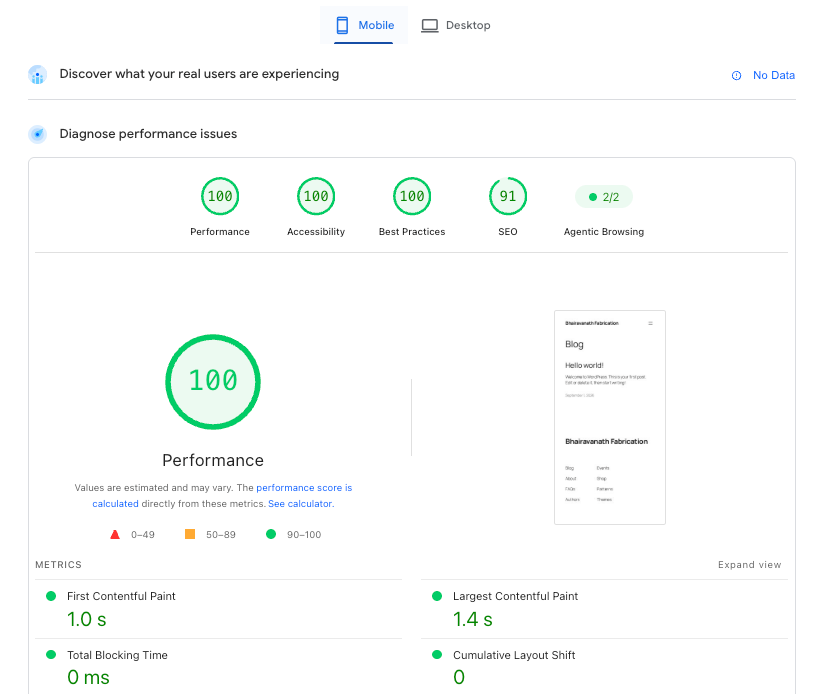
Based on my experience using Hostinger for several years, its performance is one of its strongest advantages—especially considering the price.
I’ve primarily used Hostinger for brochure-style business websites, where the hosting needs to deliver consistent page-load performance without requiring expensive infrastructure. For this type of website, I’ve found Hostinger to offer very good performance for the money.
However, hosting is only one part of website speed. Your theme, plugins, images, caching configuration, traffic and website architecture can have just as much impact.
Good Performance for the Price
If your website is a typical:
- Company website
- B2B website
- Service business website
- Consultant website
- Lead-generation website
Hostinger generally provides enough performance for the workload.
The important point is that you don’t necessarily need expensive cloud infrastructure simply because you want a fast business website.
For a well-optimized website with moderate traffic, Hostinger can provide a very good price-to-performance balance.
But Don’t Expect Unlimited Performance
As traffic and resource requirements increase, the hosting environment becomes more important.
A website with thousands of simultaneous visitors, heavy WooCommerce workloads, complex applications, or resource-intensive processes has very different requirements from a five-page company website.
That’s where you need to consider Hostinger’s higher-tier Cloud or VPS options—or potentially a different hosting provider altogether.
Our Performance Verdict
For normal business and brochure websites: Very good.
For demanding, high-traffic websites: Depends on the plan and workload.
My experience so far is that Hostinger’s performance is one of the reasons I have continued using it despite some of its other limitations.
In the next section, we’ll look at something that’s more concerning from my experience: Hostinger’s reliability and server downtime.
Hostinger Uptime & Reliability
Reliability is one area where my long-term experience with Hostinger has been less positive.
I’ve been using Hostinger for several years, and while the overall hosting experience has been good for brochure-style business websites, I’ve experienced server downtime more often than I would like.
This is important because a website can be fast when it’s online, but performance doesn’t matter if visitors occasionally can’t access it.
Is Hostinger Reliable Enough?
For a typical brochure website that isn’t highly dependent on continuous online availability, I’ve found Hostinger usable.
However, for a mission-critical business website, high-volume ecommerce store, or application where even short periods of downtime can directly affect revenue, I would be more cautious.
Hostinger publishes a 99.9% uptime guarantee, but a guarantee should not be treated as proof that your individual website will never experience downtime. Actual reliability can vary depending on the hosting environment, configuration and type of service you’re using.
Our Reliability Verdict
Performance: Strong
Long-term reliability experience: Mixed
Based on my experience, reliability is one of the areas where Hostinger has room for improvement. It’s one of the reasons I would recommend evaluating your business’s tolerance for downtime before choosing it.
Hostinger hPanel & Ease of Use
One of Hostinger’s strengths is its hPanel, the control panel used to manage hosting, domains, websites, email, backups, security and other hosting functions.
From my experience using Hostinger for several years, hPanel is relatively easy to use, particularly for business owners who don’t want to deal with traditional server-management interfaces.
Simple for Everyday Website Management
Common tasks such as:
- Installing WordPress
- Managing domains
- Setting up SSL
- Creating email accounts
- Managing backups
- Accessing website files
- Checking hosting resources
can generally be handled without much technical knowledge.
However, I haven’t seen major changes in the overall hPanel experience over the years. It remains functional and relatively straightforward, but I wouldn’t consider its evolution a major reason to choose Hostinger.
Our Verdict
Ease of use: Good
For a small business owner managing a brochure website, hPanel does what it needs to do without making hosting unnecessarily complicated.
Its biggest advantage is simplicity rather than innovation.
Hostinger for WordPress
Hostinger is a good fit for WordPress websites, particularly small business and brochure-style websites.
I’ve used Hostinger for WordPress-based business websites for several years, and my experience has been positive overall. WordPress installation and migration are straightforward, and the hosting provides the basic infrastructure most business websites need.
Good for Typical Business Websites
For websites such as:
- Company websites
- B2B websites
- Service businesses
- Consultant websites
- Lead-generation websites
Hostinger generally provides enough performance and resources without requiring a more expensive hosting setup.
The combination of WordPress support, caching, SSL, backups and CDN makes it practical for a typical business website.
Where It Starts to Become Less Ideal
The main limitation isn’t WordPress itself—it’s how demanding the website becomes.
A heavily trafficked WooCommerce store, resource-intensive WordPress installation, or website with complex functionality may eventually require more server resources or a different hosting environment.
So I wouldn’t recommend choosing Hostinger simply because it supports WordPress. Choose it based on the workload your WordPress website actually has.
Our Verdict
For small and moderate-traffic WordPress business websites: Recommended.
For demanding WordPress or ecommerce websites: Evaluate the hosting requirements carefully.
My experience with WordPress is one of the reasons I consider Hostinger a good price-to-performance option for business websites.
Hostinger Security, Backups & Website Protection
For a business website, security isn’t something you should judge by the presence of an SSL certificate alone. You need to consider SSL, backups, malware protection, account security and recovery options together.
Hostinger provides several of these protections as part of its hosting plans, including free SSL certificates, backups, CDN and other security features. The exact backup frequency and available features depend on the plan.
Backups Matter Most
From a business perspective, reliable backups are one of the most important hosting features.
If a website is hacked, incorrectly updated, or accidentally damaged, the ability to restore an earlier version can save significant time and money.
Hostinger’s backup frequency varies by plan, with higher-tier plans providing more frequent backup options. Some plans also provide on-demand backups.
However, I wouldn’t treat hosting backups as your only backup strategy.
For an important business website, I’d recommend maintaining an additional independent backup where practical. Your website, hosting account and backup shouldn’t all depend on the same provider.
Is Hostinger Secure Enough?
For a typical brochure-style business website, Hostinger provides a reasonable security foundation.
But hosting-level security doesn’t make a website completely secure. WordPress updates, plugins, themes, administrator accounts and passwords remain the website owner’s responsibility.
Our Verdict
Security: Good for typical business websites
Backups: Good, but plan-dependent
Overall protection: Suitable for most brochure websites
Hostinger provides the essential security infrastructure, but business owners shouldn’t assume that buying hosting removes the need for proper website security and independent backups.
Hostinger Customer Support: What Happens When Something Goes Wrong?
Customer support becomes important when your website isn’t working—and this is one area where my experience with Hostinger has been mixed.
Hostinger provides 24/7 customer support, but getting through to a human agent can be difficult. In my experience, AI handles many initial queries, and reaching a human can take additional effort.
Is Hostinger Support Good Enough?
For routine questions and straightforward hosting issues, the support system can be useful.
However, when you’re dealing with a complex technical problem, I’d prefer faster access to an experienced human who can understand the issue and take ownership of it.
For a business website where downtime directly affects leads or sales, this is an important consideration.
Our Verdict
Support: Average
Hostinger’s support is adequate for typical website owners, but difficulty reaching a human is a notable weakness based on my experience.
Is Hostinger Good for Business Websites?
For the type of websites I’ve used Hostinger for, yes—Hostinger is a practical choice for small and moderately sized business websites.
I’ve used it for brochure-style websites for several years, and the combination of good performance, easy website management, simple migration, and relatively low entry pricing makes it suitable for many businesses.
Where Hostinger Makes Sense
Hostinger is a good fit for:
- Small business websites
- B2B/company websites
- Service businesses
- Consultant websites
- Lead-generation websites
- Brochure-style websites
For these websites, you generally don’t need complex server infrastructure. What matters more is having reliable hosting, good performance, security, backups and an easy way to manage the website.
Where I’d Be More Cautious
I would think twice about Hostinger for:
- Mission-critical websites
- High-traffic ecommerce stores
- Resource-intensive applications
- Websites where downtime directly means significant revenue loss
- Businesses requiring immediate access to human technical support
My biggest concerns are the downtime I’ve experienced and the difficulty of reaching a human support agent.
Our Verdict
For a typical business website: Yes, Hostinger is worth considering.
Its price-to-performance ratio is one of its strongest advantages, but businesses should understand the renewal pricing and be comfortable with its limitations around reliability and support.
The right hosting choice ultimately depends on how important your website is to your business and what happens financially if that website goes offline.
Does Hostinger Scale With Your Business?
Yes, to a point. Hostinger offers a progression from basic web hosting to higher-resource Cloud hosting and VPS, so you don’t necessarily have to move providers as your website grows.
For a typical brochure-style business website, the lower-tier plans can be sufficient for years. As traffic, transactions, or resource requirements increase, you can move to a higher hosting tier with more CPU, RAM and storage.
When You May Need to Upgrade
You should consider upgrading when you start experiencing:
- Slower response times during traffic spikes
- Resource limitations
- Higher concurrent traffic
- Growing ecommerce activity
- More demanding WordPress workloads
For advanced applications or businesses requiring greater server control, VPS can provide a different level of flexibility.
The Important Limitation
Scaling isn’t simply about having a more expensive plan available.
If your business eventually requires very high reliability, specialised infrastructure, advanced server configurations, or consistently high-performance ecommerce, you may eventually be better served by another hosting environment.
Based on my experience, Hostinger is well suited to the early and middle stages of a typical business website, but I wouldn’t automatically assume it is the right infrastructure for every stage of a growing business.
Our Verdict
Scalability: Good for typical business websites, with limitations at the higher end.
For most brochure websites, you probably won’t need to worry about this for a long time. The more important question is whether your business has reached the point where hosting infrastructure itself is becoming a business constraint.
Hostinger AI Tools: Are They Actually Useful?
Hostinger has increasingly added AI-powered tools across its hosting and website-building products, including AI-assisted website creation and content-related features.
For a business owner, however, the presence of AI tools isn’t by itself a reason to choose a hosting provider.
The more useful question is whether these tools actually save time or improve the quality of your website.
Where AI Can Be Useful
Hostinger’s AI tools can be helpful for getting a basic website started, generating initial content, or assisting users who don’t have much technical experience.
For a small business owner creating a simple website, that convenience can have genuine value.
However, AI-generated websites and content still require human review, editing and business-specific input. A generic AI-generated website isn’t a substitute for a clear positioning, customer journey or conversion strategy.
Our Verdict
AI tools: Useful, but not a deciding factor.
I would consider Hostinger’s AI capabilities a nice additional benefit, rather than a primary reason to purchase its hosting.
For a serious business website, your decision should still be based primarily on performance, reliability, security, support, scalability and total cost.
The Biggest Problems With Hostinger
Hostinger offers strong value for the price, but my experience over several years has also revealed some limitations that business owners should understand before choosing it.
1. Renewal Pricing Is High
The low introductory price is one of Hostinger’s biggest attractions. However, renewal pricing is considerably higher.
If you’re planning to keep your website for several years, don’t make your decision based only on the promotional price. Calculate the long-term hosting cost before purchasing.
2. Reaching Human Support Can Be Difficult
Hostinger’s support is another area where I’ve had mixed experiences.
AI handles many initial queries, and getting connected to a human agent can be difficult. That’s not necessarily a problem for simple questions, but it can become frustrating when you’re dealing with a technical issue that requires someone to investigate the problem.
For a business website where downtime can affect leads or sales, this is worth considering.
3. Reliability Has Been a Concern
This is probably my biggest concern based on long-term use.
I’ve experienced server downtime fairly often with Hostinger. While that doesn’t mean every customer or every server will experience the same thing, it makes me more cautious about recommending Hostinger for websites where continuous availability is critical.
This is also why our uptime assessment should be based on actual monitoring rather than relying solely on Hostinger’s published uptime guarantee.
4. You May Eventually Outgrow Shared Hosting
Hostinger provides Cloud and VPS options as your requirements increase, but more hosting resources don’t automatically solve every scalability problem.
If your website becomes highly traffic-intensive, runs a demanding ecommerce operation, or requires specialised infrastructure, you may eventually need a different hosting environment.
The Bottom Line
None of these issues automatically make Hostinger a bad hosting provider.
For a typical brochure-style business website, the combination of price, performance and ease of use can still make it a very practical option.
But if your business depends heavily on maximum uptime, immediate human support or highly specialised infrastructure, I’d look beyond Hostinger.
Hostinger vs. Other Hosting Providers
Hostinger isn’t the only option, and it shouldn’t be the automatic choice for every business. The right provider depends on your budget, website workload, performance requirements, support expectations, and future growth.
For a typical business website, I’d compare Hostinger with other providers based on what you actually need rather than simply comparing feature lists.
| If your priority is… | Hostinger | Consider |
|---|---|---|
| Affordable hosting with good performance | Strong choice | — |
| Small business website | Strong choice | — |
| Easy website management | Strong choice | — |
| Premium support experience | Good | SiteGround |
| Beginner-friendly hosting | Good | Bluehost |
| More advanced infrastructure | Good | Cloudways / VPS |
| Mission-critical website | Consider carefully | Higher-end managed hosting |
When I’d Choose Hostinger
For a brochure-style business website, B2B website, consultant website or small service business, Hostinger would be one of the first providers I’d consider.
My main reasons are straightforward: good performance for the price, easy website management and simple migration.
When I’d Consider an Alternative
I’d look at other providers if reliability and immediate access to human support are more important than keeping hosting costs low.
I’d also consider alternatives when a website has significantly higher traffic, complex ecommerce requirements, or needs specialised server infrastructure.
Ultimately, there’s no universally “best” hosting provider.
Hostinger is a strong value-oriented option—but the best hosting choice is the one that matches the requirements of your business.
Who Should Use Hostinger?
Based on my several years of experience with Hostinger, I think it makes the most sense for small and moderately sized businesses that need reliable-enough hosting without paying for infrastructure they don’t need.
Hostinger is a good fit for:
- Small business websites — Company websites with moderate traffic and straightforward requirements.
- B2B websites — Brochure-style websites focused on credibility, information and lead generation.
- Service businesses — Consultants, agencies and professional service companies that primarily need their website to generate enquiries.
- WordPress websites — Businesses running relatively lightweight WordPress websites.
- Multiple small websites — Businesses or individuals managing several websites under one hosting account.
- Budget-conscious businesses — Companies that want good performance without a large initial hosting investment.
Who should think twice?
I’d be more cautious if your website is mission-critical, receives significant traffic, runs a demanding ecommerce operation, or requires immediate access to human technical support.
My concerns here are primarily based on my own experience: server downtime has been an issue, and reaching a human support agent can be difficult.
My Recommendation
If you’re building a typical brochure-style business website, Hostinger is a sensible option to consider.
If your website directly handles substantial revenue or your business cannot tolerate downtime, I’d spend more time comparing higher-reliability hosting options before making a decision.
Hostinger is best suited to businesses that need good price-to-performance—not businesses that need the most robust hosting infrastructure available.
Is Hostinger Worth It? Our Final Verdict
After using Hostinger for several years and evaluating its pricing, performance, usability, support, and suitability for business websites, I think Hostinger is worth considering—but mainly for the right type of website.
For brochure-style business websites, small businesses, B2B websites, consultants, and service businesses, Hostinger offers a strong combination of performance, ease of use and affordability.
Its biggest advantage, in my experience, is price-to-performance. The websites I’ve hosted on Hostinger have performed well without requiring expensive hosting infrastructure.
However, there are two issues I wouldn’t ignore:
- Renewal pricing is considerably higher than the introductory price.
- I’ve experienced server downtime, and reaching a human support agent can be difficult.
These limitations become more important as a website becomes more critical to the business.
When I Would Choose Hostinger
I’d choose Hostinger when the priority is:
- Good performance at a reasonable cost
- A straightforward WordPress/business website
- Easy website management
- Simple website migration
- Hosting that doesn’t require advanced server administration
When I Would Look Elsewhere
I’d consider another provider if the website:
- Is mission-critical
- Generates significant revenue directly
- Requires extremely high availability
- Needs specialised infrastructure
- Requires immediate access to experienced human support
Our Overall Verdict
Hostinger is a good value-oriented hosting provider, but it isn’t the best choice for every business.
For the typical business website I’ve worked with, I’d be comfortable recommending Hostinger. Its performance and ease of use make up for many of its limitations.
But I wouldn’t recommend choosing it simply because the introductory price is low. Look at the renewal cost, understand your website’s requirements, and decide how much downtime your business can realistically tolerate.
If you’re running a typical business or brochure website and want strong performance without spending heavily on hosting, Hostinger is a solid choice. If reliability and premium support are your highest priorities, I’d compare alternatives before making the decision.
Frequently Asked Questions About Hostinger
Is Hostinger good for business websites?
Yes. Based on my experience using Hostinger for several years, it is a good option for small and moderately sized business websites, particularly brochure-style and B2B websites. Its performance and ease of use are strong for the price.
Is Hostinger reliable?
Hostinger is generally suitable for standard websites, but my long-term experience has been mixed. I’ve experienced server downtime more often than I’d like, so I would be more cautious about using it for a mission-critical website.
Is Hostinger good for WordPress?
Yes. Hostinger is a good option for small and moderate-traffic WordPress websites. WordPress setup and migration are straightforward, and the available hosting features provide a good foundation for typical business websites.
Is Hostinger worth the price?
For many websites, yes. Its price-to-performance ratio is one of its biggest strengths. However, you should consider the renewal price rather than judging the service solely by its introductory price.
Why is Hostinger so cheap?
Hostinger uses aggressive introductory pricing and longer-term plans to keep the initial monthly cost low. The important thing is to compare the total upfront cost and renewal price, rather than looking only at the advertised monthly rate.
Is Hostinger good for beginners?
Yes. Its hPanel is relatively easy to use, and common tasks such as WordPress installation, SSL, backups and website management don’t require advanced technical knowledge.
Can I migrate my website to Hostinger?
Yes. Website migration is one of the areas I’ve found particularly easy with Hostinger. Its migration process is designed to simplify moving an existing website to the platform.
Does Hostinger have good customer support?
It’s adequate, but this is one of my criticisms. I’ve found it difficult to reach a human support agent, with AI handling many initial queries. This can become frustrating when a problem requires more detailed technical assistance.
Can Hostinger handle high-traffic websites?
It can handle more demanding websites through its higher-tier Cloud and VPS offerings, but you shouldn’t assume that every Hostinger plan is suitable for high traffic. The appropriate infrastructure depends on your website’s workload and resource requirements.
What is the best Hostinger plan for a business website?
For a straightforward small business website, Premium is a sensible starting point. Businesses that need more resources, multiple websites or additional headroom should consider Unlimited, while more demanding websites may benefit from Cloud hosting.
Should you choose Hostinger for your business?
If you need good performance, easy management and competitive pricing for a typical business website, Hostinger is worth considering.
If your business requires extremely high availability, immediate human support or specialised infrastructure, I’d compare Hostinger with other providers before making the decision.