
AI Website Development in 2026 : Why It Matters More Than Ever
Website development is changing faster than ever before. In 2026, businesses are no longer asking whether artificial intelligence (AI) can build a website—they’re asking which AI website builder they should use and whether it can replace traditional website development.
Modern AI website development platforms can generate complete websites in minutes. With a simple prompt, AI can create layouts, write content, generate images, build landing pages, and even publish a live website without requiring coding knowledge. This shift is making website creation faster, more affordable, and more accessible for startups, small businesses, entrepreneurs, and even experienced web developers.
However, speed isn’t everything.
While AI website builders offer significant advantages, they also introduce important considerations around SEO, branding, customization, security, scalability, performance, and long-term ownership. Choosing the wrong approach can lead to generic websites, limited flexibility, or costly migrations later.
This comprehensive guide explores everything you need to know about AI website development in 2026, including:
- What AI website development actually means
- How AI website builders work
- The best AI website builders available today
- Benefits and limitations of AI-generated websites
- Real-world business use cases
- SEO implications and Google rankings
- AI website builder vs traditional website development
- When AI is the right choice—and when it isn’t
- The future of AI-powered website development
Whether you’re a business owner, marketer, startup founder, freelancer, or web developer, this guide will help you understand where AI fits into modern web development and how to make informed decisions for your next website project.
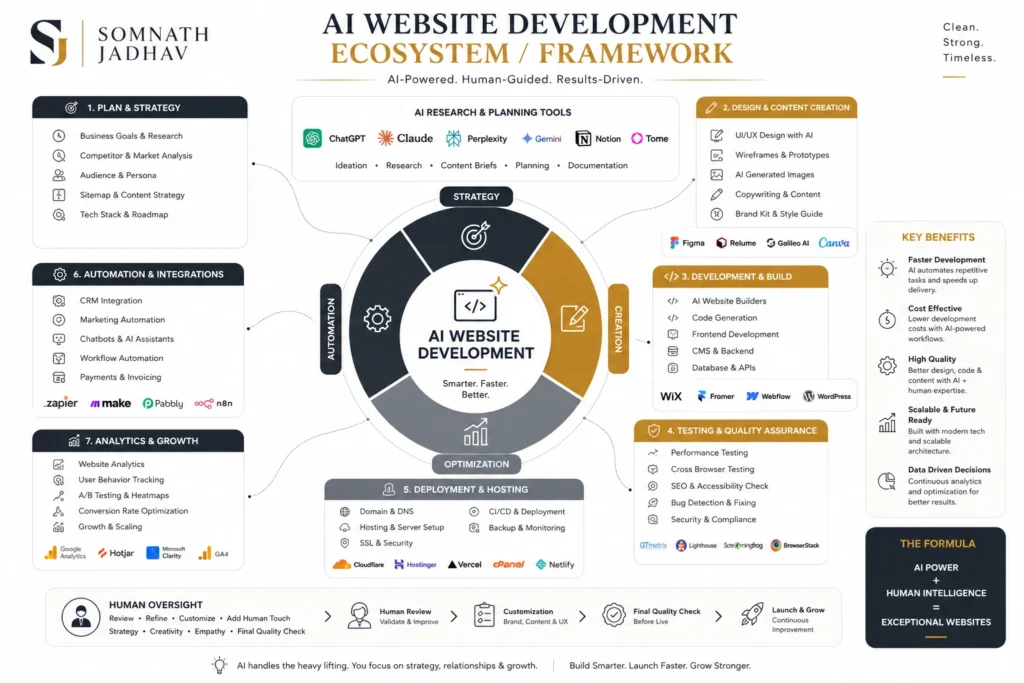
The framework above illustrates the complete AI website development lifecycle—from strategy and planning to launch, optimisation, and continuous improvement. While AI accelerates research, design, content creation, coding, and testing, human expertise remains essential for strategy, creativity, and quality assurance.
Updated: July 2026
Reading Time: 47 minutes
Last Reviewed By: Somnath Jadhav
Research Sources: Google, OpenAI, Anthropic, leading AI website builders
Table of Contents
Quick Definition
AI website development is the process of creating, designing, and maintaining websites using artificial intelligence technologies. AI website builders can automatically generate layouts, content, images, and code from simple text prompts, significantly reducing the time and technical expertise required to build a website.
Source: Definition based on industry practices and documentation from leading AI website development platforms.
Why Read This Guide?
Most articles focus on listing AI website builders.
This guide goes much further by helping you understand:
- The technology behind AI website development
- The business impact of AI-built websites
- The SEO opportunities and limitations
- The risks that most reviews overlook
- How to choose the right AI website solution for your business
- What the future of AI-powered web development looks like
Rather than promoting a single tool, this guide provides an objective, practical framework to help you evaluate AI website development based on your business goals.
Unlike tool reviews that focus on a single platform, this guide compares AI website builders objectively, explains their limitations, explores real business use cases, and helps you decide when AI is sufficient and when professional web development remains the better investment.
Learn more in our guide on What Is an AI Website Builder?
AI Website Development at a Glance
- AI website builders are among the fastest-growing website creation categories.
- Many AI builders can generate a website in under 5 minutes.
- AI can assist with design, content, code, images, and SEO.
- Human expertise is still essential for branding, strategy, and complex development.
What Is AI Website Development?
AI website development is the process of planning, designing, building, optimizing, and maintaining websites with the help of artificial intelligence. Instead of creating every page, layout, image, or line of code manually, AI-powered tools automate many aspects of website development while allowing human oversight for strategy, branding, and customization.
Modern AI website development platforms can generate complete websites from a simple text prompt. They use large language models (LLMs), machine learning, and automation to create page layouts, write website copy, generate images, produce code, optimize SEO, and even publish websites with minimal manual effort.
Although AI can significantly reduce development time and costs, it is not a complete replacement for human expertise. Successful websites still depend on clear business goals, strong branding, user experience (UX), technical SEO, and ongoing optimization.
Quick Answer
AI website development is the use of artificial intelligence to create, design, optimize, and maintain websites faster than traditional development methods. AI can generate layouts, content, images, code, and SEO recommendations while allowing users to customize the final website according to their business needs.
AI Website Development vs AI Website Builder
Many people use these terms interchangeably, but they are not the same.
| AI Website Development | AI Website Builder |
|---|---|
| A complete process of building and maintaining websites using AI technologies. | A software platform that helps users create websites with AI assistance. |
| Includes planning, design, coding, SEO, testing, and optimization. | Primarily focuses on generating and publishing websites quickly. |
| May involve developers, designers, marketers, and AI tools working together. | Designed for non-technical users and small businesses. |
| Can use multiple AI tools throughout the workflow. | Usually relies on a single platform’s built-in AI capabilities. |
In simple terms: An AI website builder is one tool within the broader process of AI website development.
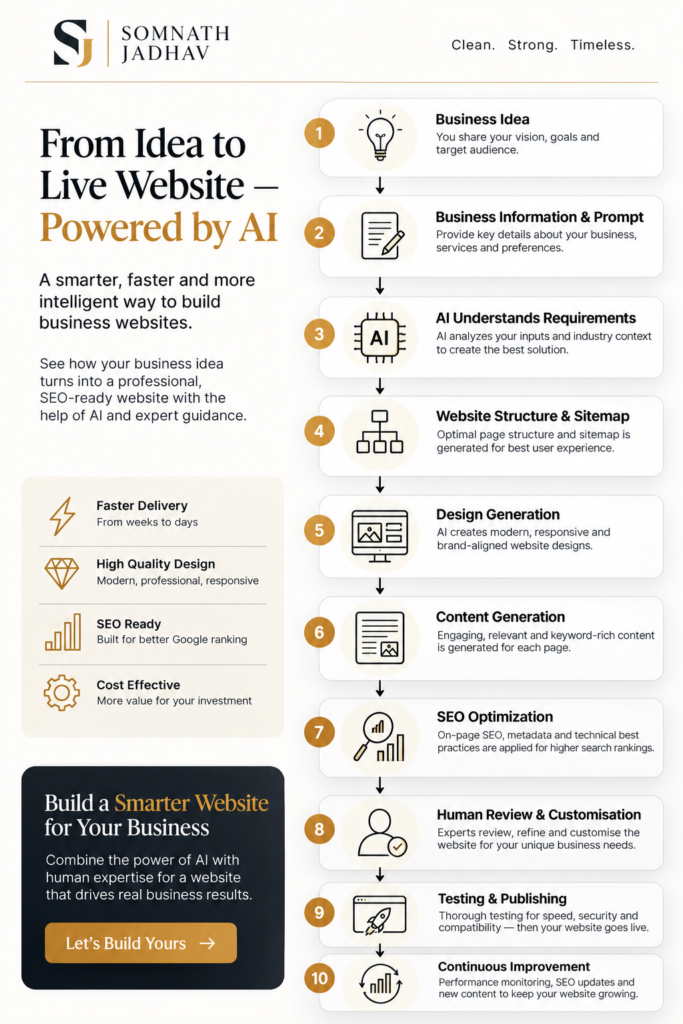
Most AI website development platforms follow a similar workflow:
- You describe your business, product, or idea.
- AI analyzes your requirements.
- The platform generates a website structure and navigation.
- AI creates layouts and page designs.
- Content, headlines, and calls to action are generated.
- Images, icons, and branding elements are suggested or created.
- SEO metadata and technical settings are automatically configured.
- You review, edit, and publish the website.
This combination of automation and human review enables businesses to launch websites much faster than traditional development workflows.
Key Components of AI Website Development
AI website development extends far beyond generating a homepage. Modern platforms can assist throughout the website lifecycle, including:
- Website planning and information architecture
- Wireframe and layout generation
- User interface (UI) design
- User experience (UX) recommendations
- Content writing and copy generation
- AI-generated images and graphics
- Code generation and debugging
- Search engine optimization (SEO)
- Accessibility improvements
- Performance optimization
- Website testing
- Ongoing maintenance and updates
Common Technologies Behind AI Website Development
Several technologies work together to power AI website development.
Large Language Models (LLMs)
LLMs understand prompts and generate website content, code, and recommendations.
Examples include ChatGPT, Claude, and Gemini.
Generative AI
Generative AI creates new content such as images, layouts, icons, and marketing copy instead of simply retrieving existing information.
Machine Learning
Machine learning enables AI systems to improve design recommendations, user experiences, and personalization based on patterns and data.
Automation
Automation connects multiple website tasks such as publishing, SEO optimization, image generation, testing, and content updates into a streamlined workflow.
AI website development combines artificial intelligence with modern web technologies to automate tasks such as planning, design, content creation, coding, and optimization. Throughout this guide, you’ll learn how AI website development works, explore its advantages and limitations, compare leading AI website builders, and discover how businesses can use AI to build faster, smarter, and more effective websites.
How AI Website Development Works
AI website development combines artificial intelligence, automation, and modern web technologies to simplify the website creation process. Instead of building every page manually, users provide business information and goals, while AI generates a functional website that can be customized before publishing.
Although the workflow varies between platforms, most AI website builders follow a similar process.
Typical AI Website Development Workflow
Step 1: Understand Your Business
The process begins by collecting information about your business.
Most AI website development platforms ask questions such as:
- What is your business or website about?
- Who is your target audience?
- What products or services do you offer?
- What style or design do you prefer?
- What pages do you need?
- What are your primary business goals?
Some advanced platforms also allow you to describe your requirements using a natural language prompt, similar to interacting with an AI chatbot.
Example Prompt:
Create a modern website for a digital marketing agency with Home, About, Services, Case Studies, Blog, and Contact pages. Use a professional blue and white color scheme and optimize the content for SEO.
Step 2: AI Generates the Website Structure
Once the requirements are understood, AI creates the website’s information architecture.
This typically includes:
- Navigation menu
- Sitemap
- Page hierarchy
- Content sections
- Calls-to-action (CTAs)
- User journey recommendations
Instead of starting with a blank page, users receive a structured website that can be refined further.
Step 3: AI Designs the Website
The platform then generates the visual design.
Depending on the tool, AI may automatically create:
- Website layouts
- Color palettes
- Typography
- Icons
- Images
- Section spacing
- Responsive page designs
Many AI website builders also generate multiple design variations, allowing users to choose the style that best matches their brand.
Step 4: AI Creates Content
Content generation is one of the biggest advantages of AI website development.
AI can generate:
- Headlines
- Hero sections
- Service descriptions
- Product information
- About Us content
- Blog ideas
- Frequently Asked Questions (FAQs)
- Meta titles and descriptions
- Calls-to-action
While AI provides an excellent starting point, the content should always be reviewed, edited, and fact-checked to ensure accuracy and align with your brand voice.
Step 5: AI Assists with SEO
Many modern AI website builders include built-in SEO features.
These may include:
- SEO-friendly page titles
- Meta descriptions
- Heading recommendations
- Image alt text
- Internal linking suggestions
- Schema markup support
- XML sitemap generation
- Basic keyword recommendations
These features help improve search visibility, but they should complement—not replace—a comprehensive SEO strategy.
Step 6: Review, Customize, and Publish
Before launching the website, users can customize:
- Branding
- Colors
- Typography
- Images
- Content
- Layouts
- Contact information
- Forms
- Navigation
After reviewing the website, it can be published to a custom domain or the platform’s hosting environment.
The Human Role in AI Website Development
AI accelerates website creation, but human expertise remains essential.
Professionals still add value by:
- Defining business strategy
- Creating unique branding
- Writing high-quality content
- Improving user experience (UX)
- Optimizing technical SEO
- Ensuring accessibility
- Reviewing AI-generated content
- Maintaining website security
- Improving conversion rates
- Scaling the website over time
The most successful websites combine AI’s speed with human creativity, strategy, and technical expertise
Types of AI Website Development
Not all AI website development solutions work the same way. Some platforms generate complete websites from a single prompt, while others help developers write code, create designs, or automate specific tasks.
Understanding these different approaches will help you choose the right solution based on your technical skills, business goals, and project complexity.
Broadly, AI website development can be divided into four categories.
1. AI Website Builders
AI website builders are designed to help individuals and businesses create websites quickly without requiring programming knowledge. These platforms use artificial intelligence to generate layouts, content, images, and basic website structures based on user input.
Most AI website builders also include hosting, templates, drag-and-drop editing, and built-in SEO features, making them an ideal choice for beginners and small businesses.
Best suited for:
- Small businesses
- Freelancers
- Startups
- Personal websites
- Local businesses
- Portfolio websites
- Landing pages
Popular examples include:
- Wix AI
- Hostinger Website Builder
- Framer AI
- Squarespace AI
- Shopify AI
- Durable
- 10Web
Note: We’ll compare these platforms in detail later in this guide.
2. AI Coding Platforms
AI coding platforms assist developers by generating, explaining, debugging, and optimizing code. Rather than building an entire website automatically, these tools work alongside developers to improve productivity and reduce repetitive tasks.
They are particularly useful for creating custom websites, web applications, APIs, and advanced digital products.
Common capabilities include:
- Code generation
- Code completion
- Debugging assistance
- Refactoring
- Documentation
- Framework recommendations
- Error detection
Popular examples include:
- ChatGPT
- Claude
- GitHub Copilot
- Cursor
- Bolt
- v0 by Vercel
- Replit AI
Best suited for:
- Web developers
- Software engineers
- Agencies
- SaaS companies
- Custom website projects
3. AI Design Tools
AI design tools focus on the visual side of website development. They help designers generate user interfaces (UI), wireframes, layouts, color palettes, and design systems before development begins.
These tools accelerate the design process while allowing designers to maintain creative control.
Typical features include:
- Wireframe generation
- UI design suggestions
- Design systems
- Component creation
- Color recommendations
- Responsive layouts
- Design-to-code workflows
Popular examples include:
Best suited for:
- UI/UX designers
- Design agencies
- Product teams
- Startups
4. Hybrid AI + Human Website Development
For many businesses, the most effective approach is a combination of AI and human expertise.
In this model, AI automates repetitive tasks such as content generation, layout creation, and coding assistance, while experienced professionals focus on strategy, branding, user experience, SEO, accessibility, security, and business objectives.
This collaborative workflow combines AI’s speed with human creativity and decision-making.
A typical hybrid workflow might look like this:
- AI generates the initial website structure.
- Designers refine the visual identity.
- Developers customize functionality.
- SEO specialists optimize content and technical SEO.
- Marketers improve messaging and conversions.
- Business owners review the final website before launch.
For businesses seeking long-term growth and differentiation, this approach often delivers the best balance of efficiency, flexibility, and quality.
Which Type Is Right for You?
The best choice depends on your requirements.
| Requirement | Recommended Solution |
|---|---|
| Build a website quickly with minimal technical knowledge | AI Website Builder |
| Develop a highly customized website or application | AI Coding Platform |
| Create professional UI/UX designs | AI Design Tool |
| Build a scalable, branded, SEO-focused business website | Hybrid AI + Human Development |
There is no one-size-fits-all solution. The right approach depends on your budget, technical expertise, customization needs, and long-term business goals.
Benefits of AI Website Development
Artificial intelligence is transforming how websites are planned, designed, and launched. Tasks that once required weeks of collaboration between designers, developers, copywriters, and SEO specialists can now be completed much faster with AI-assisted tools.
For businesses, AI website development offers significant advantages in speed, efficiency, and accessibility. However, the greatest value comes from using AI to enhance human expertise rather than replace it.
Below are the key benefits of AI website development in 2026.
1. Faster Website Development
One of the biggest advantages of AI website development is speed.
Instead of starting with a blank page, AI can generate a complete website structure, layouts, navigation, and initial content within minutes. This allows businesses to move from idea to prototype much faster than traditional workflows.
Whether you’re launching a startup, validating a business idea, or creating a campaign landing page, AI significantly reduces development time.
2. Lower Development Costs
Traditional website development often involves multiple specialists, including designers, developers, content writers, and SEO professionals.
AI automates many repetitive tasks, reducing the time and effort required to complete a project. This can lower initial development costs, particularly for simple business websites and landing pages.
While complex websites still require professional expertise, AI makes quality website creation more accessible for startups and small businesses.
3. Increased Productivity
AI doesn’t just help non-technical users—it also improves productivity for experienced professionals.
Developers can generate boilerplate code, designers can create wireframes more quickly, and marketers can draft website copy in a fraction of the time.
By automating repetitive work, teams can spend more time on strategy, creativity, and solving business problems.
4. No Coding Knowledge Required
Many AI website builders are designed for users with little or no technical experience.
Through guided questions or natural language prompts, users can generate websites without writing HTML, CSS, or JavaScript.
This lowers the barrier to entry for entrepreneurs, freelancers, and small business owners who want to establish an online presence quickly.
5. Faster Content Creation
Writing website content is often one of the most time-consuming stages of a project.
AI can assist by generating:
- Headlines
- Service descriptions
- Product content
- About Us pages
- Frequently Asked Questions (FAQs)
- Calls-to-action
- Meta titles and descriptions
Although AI accelerates content creation, every page should be reviewed for accuracy, originality, and brand consistency before publishing.
6. AI-Assisted SEO
Many AI website development platforms include built-in SEO features that help improve website visibility.
Common capabilities include:
- Title tag suggestions
- Meta description generation
- Heading recommendations
- Image alt text
- XML sitemap creation
- Internal linking suggestions
- Basic keyword recommendations
These features provide a strong starting point, but effective SEO still requires ongoing optimization, high-quality content, technical improvements, and a long-term content strategy.
7. Rapid Prototyping and MVP Development
Businesses can use AI to quickly build prototypes, proof-of-concept websites, and minimum viable products (MVPs).
Instead of spending weeks developing an initial version, teams can validate ideas, collect user feedback, and iterate much faster.
This is particularly valuable for startups, product launches, and marketing campaigns.
8. Easier Website Maintenance
AI is increasingly being used to support ongoing website management.
Depending on the platform, AI can assist with:
- Content updates
- SEO recommendations
- Performance monitoring
- Image optimization
- Error detection
- Accessibility suggestions
- Content improvements
While human oversight remains essential, AI can reduce the time required for routine maintenance tasks.
9. Better Personalization
Some AI-powered platforms can personalize website experiences based on user behavior, preferences, or location.
Examples include:
- Personalised content recommendations
- Dynamic calls-to-action
- Product suggestions
- Localized messaging
- Tailored landing pages
This can improve user engagement and conversion rates when implemented thoughtfully.
10. Improved Scalability
AI makes it easier to expand websites over time.
Businesses can quickly generate new landing pages, service pages, blog content, FAQs, and marketing assets while maintaining consistent branding and messaging.
For organisations managing multiple campaigns or locations, AI can significantly reduce content production time.
Summary of Benefits
| Benefit | Business Impact |
|---|---|
| Faster development | Launch websites in hours or days instead of weeks |
| Lower costs | Reduce manual effort for standard projects |
| Higher productivity | Free teams to focus on strategy and innovation |
| No coding required | Make website creation accessible to non-technical users |
| Faster content creation | Accelerate website copy and marketing content |
| AI-assisted SEO | Improve on-page optimization and discoverability |
| Rapid prototyping | Validate ideas before major investment |
| Easier maintenance | Simplify routine updates and optimization |
| Better personalization | Enhance user experience and engagement |
| Improved scalability | Expand websites more efficiently |
Important Consideration
While these benefits are significant, AI is not a complete replacement for professional website strategy or development.
Businesses that require strong branding, custom functionality, advanced integrations, or long-term scalability often achieve the best results by combining AI tools with experienced designers, developers, and SEO professionals.
The goal should be to use AI as an accelerator—not as a substitute for sound planning and expertise.
Risks and Limitations of AI Website Development
AI website development has made creating websites faster and more accessible, but it is not a perfect solution for every project. While AI can automate many tasks, it still has limitations that businesses should understand before relying on it completely.
Knowing these challenges will help you choose the right approach and avoid costly mistakes.
1. Limited Customization
AI website builders are designed to generate websites quickly using predefined templates and design patterns. While this approach saves time, it can limit flexibility when creating unique layouts or advanced functionality.
Businesses with complex requirements often need custom development to achieve their goals.
Examples include:
- Custom dashboards
- Membership portals
- Booking systems
- Enterprise applications
- Complex integrations
- Industry-specific workflows
For these projects, AI works best as an assistant rather than a replacement for professional development.
2. Generic Content
AI can generate website copy within minutes, but the content may lack originality, brand personality, or industry expertise.
Common issues include:
- Repetitive wording
- Generic messaging
- Weak calls-to-action
- Factual inaccuracies
- Outdated information
- Inconsistent tone
Every AI-generated page should be reviewed, edited, and fact-checked before publication.
3. SEO Limitations
Many AI website builders include basic SEO features, but they cannot replace a comprehensive SEO strategy.
Successful SEO requires:
- Keyword research
- Search intent analysis
- Technical optimization
- Internal linking
- High-quality content
- Link building
- Ongoing performance monitoring
Without these elements, even a well-designed AI-generated website may struggle to achieve strong search rankings.
4. Design Similarity
Because AI models are trained on existing design patterns, many AI-generated websites can look similar.
This may reduce brand differentiation, especially in competitive industries where a unique visual identity is important.
Businesses that want to stand out often benefit from custom design and branding.
5. Limited Business Understanding
AI understands prompts, but it does not truly understand your business, customers, or long-term strategy.
It cannot independently determine:
- Your unique value proposition
- Market positioning
- Customer emotions
- Competitive advantages
- Sales strategy
- Business priorities
These decisions require human expertise and strategic thinking.
6. Privacy and Data Security Concerns
Some AI platforms process prompts, content, or uploaded files through cloud-based services.
Businesses should review:
- Privacy policies
- Data handling practices
- Security measures
- Compliance requirements
- Data retention policies
Organizations working with sensitive customer information or regulated industries should be particularly cautious when using AI tools.
For a deeper look at the security risks associated with AI-built and AI-powered websites, see our guide to AI Website Security.
7. Platform Dependency
Many AI website builders operate within proprietary ecosystems.
Moving your website to another platform later may involve:
- Rebuilding pages
- Recreating designs
- Migrating content
- Replacing features
- Additional development costs
Before choosing a platform, consider its flexibility, export options, and long-term scalability.
8. Inaccurate or Hallucinated Information
Large language models can occasionally generate incorrect, outdated, or misleading information with confidence.
This is especially risky for websites covering topics such as:
- Healthcare
- Finance
- Legal services
- Technical documentation
Always verify AI-generated content using reliable sources before publishing.
9. Accessibility and Compliance Gaps
AI can assist with accessibility, but it cannot guarantee compliance with standards such as WCAG.
Human review is still necessary to evaluate:
- Keyboard navigation
- Screen reader compatibility
- Color contrast
- Form accessibility
- Alternative text quality
Accessibility testing should be part of every professional website launch.
10. Overreliance on AI
One of the biggest risks is assuming AI can replace strategy, creativity, and professional expertise.
A successful website depends on more than attractive design or generated content. It requires clear business goals, user-focused experiences, technical performance, effective marketing, and continuous improvement.
AI is a powerful productivity tool, but long-term success still depends on informed human decision-making.
Common Challenges at a Glance
| Risk | Potential Impact |
|---|---|
| Limited customization | Difficult to build advanced features |
| Generic content | Weak brand differentiation |
| Basic SEO | Lower organic visibility without optimization |
| Similar designs | Reduced competitive advantage |
| Limited business understanding | Poor strategic decisions |
| Privacy concerns | Compliance and security risks |
| Platform dependency | Vendor lock-in and migration challenges |
| AI inaccuracies | Incorrect or misleading information |
| Accessibility gaps | Poor user experience and compliance issues |
| Overreliance on AI | Missed opportunities for growth and innovation |
How to Reduce These Risks
You can minimize most AI website development risks by following a few best practices:
AI Website Development vs Traditional Website Development
One of the biggest decisions businesses face today is whether to use AI website development or invest in traditional website development.
The right choice depends on your business goals, budget, timeline, and the level of customization your website requires.
AI website development excels at creating websites quickly and cost-effectively, making it ideal for standard business websites, portfolios, and landing pages. Traditional website development, however, offers complete flexibility, deeper customization, and greater scalability for businesses with complex requirements.
Rather than asking which approach is better, it’s more useful to ask which approach is better for your specific project.
Quick Comparison
| Feature | AI Website Development | Traditional Website Development |
|---|---|---|
| Development Speed | Very fast | Moderate to slow |
| Initial Cost | Lower | Higher |
| Technical Skills Required | Minimal | Professional expertise required |
| Customization | Limited to moderate | Nearly unlimited |
| SEO Control | Basic built-in tools | Full control over technical and on-page SEO |
| Scalability | Suitable for standard websites | Suitable for projects of any complexity |
| Integrations | Platform-dependent | Extensive custom integrations |
| Best For | Small businesses, startups, portfolios | Growing businesses, enterprises, custom solutions |
Development Speed
AI website builders can generate a functional website within minutes or hours by automating tasks such as layout creation, content generation, and basic design.
Traditional website development follows a structured process that includes planning, design, development, testing, and optimization. While it takes longer, it provides greater flexibility and control over the final product.
Best Choice: AI Website Development for speed.
Cost
AI website development generally requires a lower upfront investment because many repetitive tasks are automated.
Traditional website development involves professional designers, developers, and other specialists, making it more expensive initially. However, for businesses that need a highly customized or scalable solution, this investment often provides greater long-term value.
Best Choice: AI Website Development for budget-conscious projects.
Customization
Customization is one of the biggest differences between the two approaches.
AI website builders allow users to personalize templates and layouts, but advanced functionality is often limited by the platform.
Traditional website development gives businesses complete control over design, functionality, integrations, and user experience. It is the preferred choice for organizations that require unique features or industry-specific workflows.
Best Choice: Traditional Website Development.
SEO Capabilities
Most AI website builders include essential SEO features such as editable metadata, XML sitemaps, and basic optimization tools.
Traditional website development offers greater flexibility for implementing advanced SEO strategies, including custom website architecture, structured data, Core Web Vitals optimization, internal linking strategies, and technical SEO improvements.
Businesses that rely heavily on organic search traffic often benefit from the additional control provided by traditional development.
Best Choice: Traditional Website Development.
Scalability
AI website builders are well suited for simple websites that require standard functionality.
As businesses grow, they may need advanced capabilities such as customer portals, custom applications, API integrations, multilingual websites, or enterprise-level features. Traditional website development is generally better equipped to support these evolving requirements.
Best Choice: Traditional Website Development.
Which Option Is Right for You?
Choose AI Website Development if you:
- Need a website quickly
- Have a limited budget
- Require a standard business website
- Have little or no coding experience
- Want to launch a landing page or validate a business idea
Choose Traditional Website Development if you:
- Need custom functionality
- Want a unique brand experience
- Require advanced integrations
- Expect your website to scale significantly
- Depend on long-term SEO and digital growth
- Need complete ownership and flexibility
Comparison Summary
| Business Requirement | Recommended Approach |
|---|---|
| Launch quickly | AI Website Development |
| Minimize upfront costs | AI Website Development |
| Build a brochure or portfolio website | AI Website Development |
| Develop a custom business website | Traditional Website Development |
| Create advanced functionality | Traditional Website Development |
| Scale for future growth | Traditional Website Development |
| Maximize long-term SEO potential | Traditional Website Development |
Best AI Website Builders in 2026
The rapid growth of artificial intelligence has led to dozens of AI-powered website builders entering the market. While many platforms promise to create websites in minutes, they differ significantly in terms of customization, ease of use, pricing, eCommerce capabilities, and scalability.
The best AI website builder for you depends on your technical expertise, business goals, and the type of website you want to build.
Below are some of the leading AI website builders in 2026.
1. Wix AI
Wix AI is one of the most mature AI website builders available today. It uses conversational prompts to generate website layouts, content, images, and page structures tailored to your business.
Pros
- Beginner-friendly interface
- Large template library
- Built-in SEO tools
- App marketplace with hundreds of integrations
- Suitable for most small businesses
Cons
- Limited flexibility compared to custom development
- Advanced customisation can become restrictive
Best For: Small businesses, freelancers, consultants, and portfolio websites.
2. Hostinger Website Builder
Hostinger combines AI-powered website generation with affordable hosting, making it an attractive option for startups and budget-conscious businesses.
Pros
- Affordable pricing
- AI content generation
- Logo and image creation tools
- Simple drag-and-drop editor
Cons
- Fewer integrations than larger platforms
- Limited advanced functionality
Best For: Personal websites, startups, and small business websites.
3. Framer AI
Framer AI focuses on modern, visually appealing websites with an emphasis on responsive design and rapid prototyping.
It is popular among designers, agencies, and startups looking for sleek landing pages and marketing websites.
Pros
- Modern UI
- Excellent design quality
- Fast publishing
- Responsive layouts
Cons
- Learning curve for beginners
- Better suited to content-driven websites than complex business applications
Best For: Startups, agencies, designers, and SaaS landing pages.
4. Squarespace AI
Squarespace integrates AI features into its website-building platform while maintaining its reputation for premium templates and design quality.
Pros
- Professional templates
- Strong blogging capabilities
- Built-in marketing tools
- Good eCommerce support
Cons
- Less flexible than fully custom websites
- Smaller extension ecosystem
Best For: Creative professionals, restaurants, photographers, and service businesses.
5. Shopify Magic
Shopify Magic brings AI capabilities to one of the world’s leading eCommerce platforms.
Rather than generating entire websites, it focuses on helping merchants create product descriptions, marketing content, customer support responses, and store management tasks.
Pros
- Excellent eCommerce ecosystem
- AI-powered product content
- Inventory and store management features
- Extensive app marketplace
Cons
- Primarily designed for online stores
- Monthly costs increase with additional apps
Best For: eCommerce businesses and online retailers.
6. Durable
Durable is designed to generate a simple business website within minutes.
It combines AI website generation with CRM, invoicing, and marketing tools, making it attractive for freelancers and local businesses.
Pros
- Extremely fast setup
- Beginner-friendly
- Integrated business tools
- AI-generated content
Cons
- Limited customization
- Better suited for simple websites
Best For: Local businesses, freelancers, and service providers.
7. 10Web AI Builder
10Web combines AI website generation with WordPress, giving users more flexibility than many standalone AI website builders.
Users can generate WordPress websites and continue customizing them using the WordPress ecosystem.
Pros
- WordPress-based
- Greater customization
- AI website recreation
- Good performance optimization tools
Cons
- Requires basic WordPress familiarity
- More complex than beginner-focused builders
Best For: WordPress users, agencies, and businesses that want greater flexibility.
AI Website Builder Comparison
| Platform | Best For | Ease of Use | Customization | eCommerce | SEO |
|---|---|---|---|---|---|
| Wix AI | Small businesses | ⭐⭐⭐⭐⭐ | ⭐⭐⭐ | ⭐⭐⭐⭐ | ⭐⭐⭐⭐ |
| Hostinger | Beginners | ⭐⭐⭐⭐⭐ | ⭐⭐⭐ | ⭐⭐ | ⭐⭐⭐ |
| Framer AI | Designers & startups | ⭐⭐⭐⭐ | ⭐⭐⭐⭐ | ⭐⭐ | ⭐⭐⭐⭐ |
| Squarespace AI | Creative businesses | ⭐⭐⭐⭐ | ⭐⭐⭐ | ⭐⭐⭐⭐ | ⭐⭐⭐⭐ |
| Shopify Magic | Online stores | ⭐⭐⭐⭐ | ⭐⭐⭐⭐ | ⭐⭐⭐⭐⭐ | ⭐⭐⭐⭐ |
| Durable | Freelancers | ⭐⭐⭐⭐⭐ | ⭐⭐ | ⭐⭐ | ⭐⭐⭐ |
| 10Web | WordPress users | ⭐⭐⭐⭐ | ⭐⭐⭐⭐⭐ | ⭐⭐⭐⭐ | ⭐⭐⭐⭐ |
Which AI Website Builder Should You Choose?
Your ideal platform depends on your requirements.
| If You Need… | Recommended Platform |
|---|---|
| A beginner-friendly website builder | Wix AI |
| The most affordable option | Hostinger Website Builder |
| Beautiful landing pages | Framer AI |
| A creative portfolio website | Squarespace AI |
| An AI-powered online store | Shopify Magic |
| The fastest website setup | Durable |
| WordPress flexibility | 10Web AI Builder |
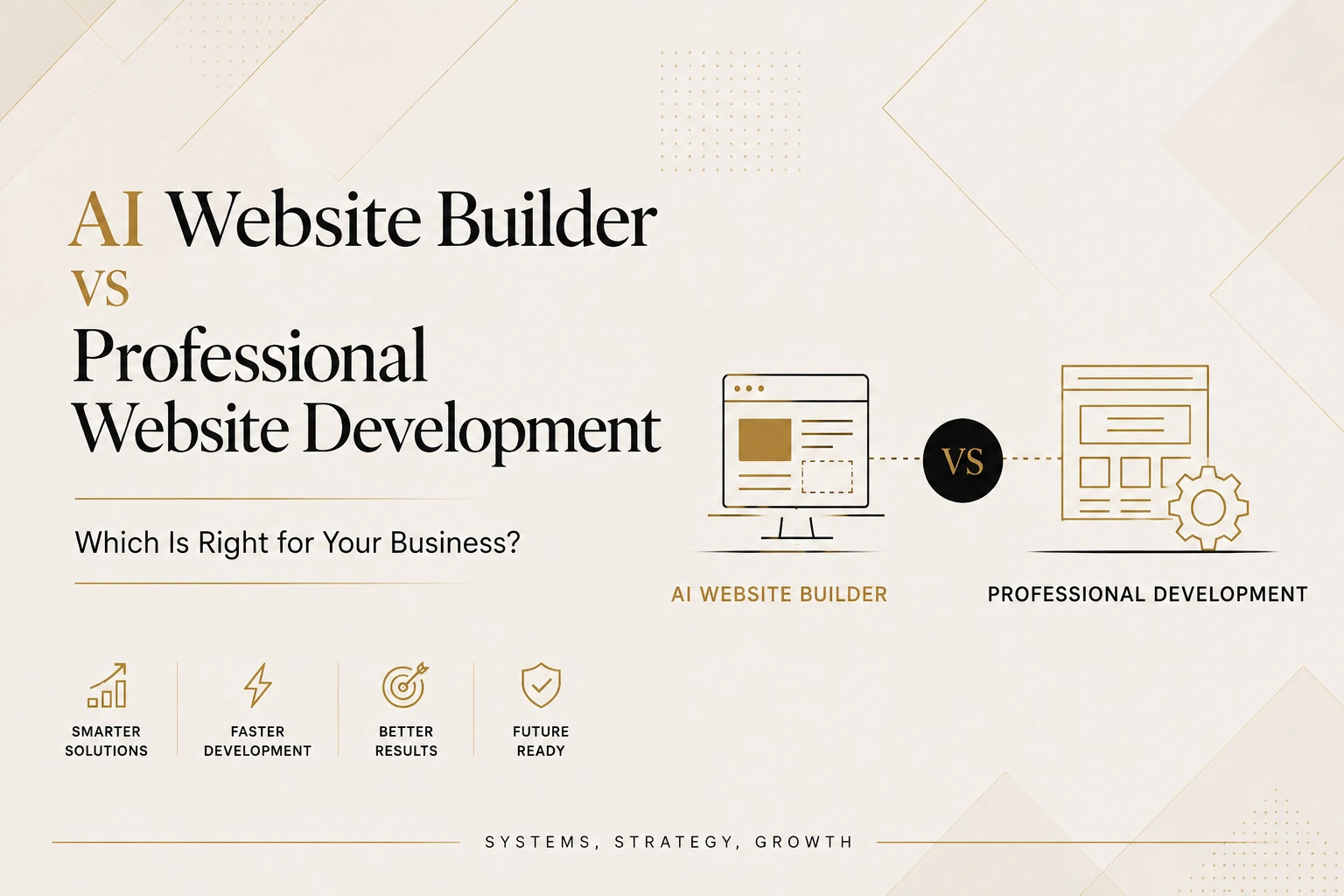
Choosing an AI website builder is only part of the decision. For businesses evaluating whether to use an AI website builder or work with a professional development team, the right choice depends on factors such as business requirements, customization, scalability, integrations, security, and long-term goals. Our guide to AI Website Builder vs Professional Development compares the two approaches in detail.
Are AI Website Builders Enough for Growing Businesses?
AI website builders are an excellent solution for many personal websites, startups, and small businesses. They reduce development time and simplify website creation, allowing users to launch quickly.
However, as businesses grow, they often require capabilities beyond what most AI website builders offer, such as:
- Custom functionality
- Third-party integrations
- Advanced SEO strategies
- Unique branding
- Performance optimization
- Scalable architecture
- Industry-specific workflows
In these cases, businesses may benefit from combining AI tools with professional website development services to achieve greater flexibility and long-term scalability.
But can AI actually build a professional business website? A website can look polished while still lacking the strategy, positioning, content, and conversion structure a business needs. Our detailed guide, Can AI Build a Professional Business Website?, explores where AI website builders work well—and where professional expertise still matters.
AI Website Development Use Cases
AI website development is versatile enough to support a wide range of websites, from personal portfolios to business websites and online stores. By automating tasks such as layout design, content generation, and basic SEO, AI enables businesses to launch websites more quickly and cost-effectively.
However, not every project has the same requirements. While AI is an excellent choice for many standard websites, businesses with complex workflows, advanced integrations, or highly customized functionality may require traditional development or a hybrid approach.
Below are the most common use cases where AI website development delivers the greatest value.
1. Small Business Websites
AI website builders are ideal for small businesses that need a professional online presence without a lengthy development process.
They can quickly generate essential pages such as Home, About, Services, Contact, and FAQs, making them well suited for local businesses, consultants, freelancers, and service providers.
2. Startup Websites and Landing Pages
For startups, speed is often more important than perfection.
AI website development enables founders to launch landing pages, validate ideas, collect leads, and showcase products or services within hours instead of weeks. It is an effective solution for MVPs, product launches, and marketing campaigns.
3. eCommerce Websites
Many AI website builders now support online stores with features like product catalogs, payment gateways, inventory management, and AI-generated product descriptions.
They work well for small to medium-sized online stores. However, businesses with complex inventory systems, custom pricing, or enterprise-level requirements may benefit from custom eCommerce development.
4. Portfolio and Personal Websites
Creative professionals, freelancers, photographers, designers, and developers can use AI to build visually appealing portfolio websites with minimal effort.
Most AI website builders provide modern templates that make it easy to showcase work and attract potential clients.
Is AI Website Development Right for Your Business?
The table below provides a quick overview of where AI website development is most suitable.
| Business Type | AI Website Development |
|---|---|
| Small Business | ✅ Excellent Choice |
| Startup | ✅ Excellent Choice |
| Portfolio Website | ✅ Excellent Choice |
| Blog or Content Website | ✅ Good Choice |
| eCommerce Store | ✅ Good for Small to Medium Stores |
| Manufacturing Business | ⚠️ Depends on Requirements |
| Enterprise Website | ❌ Traditional Development Recommended |
Can AI-Built Websites Rank on Google?
Yes, AI-built websites can rank on Google.
Google does not rank or penalize websites simply because they were created using artificial intelligence. Instead, Google’s ranking systems evaluate the overall quality, relevance, and usefulness of a website, regardless of whether it was built manually or with AI.
In other words, how your website is built matters far less than how well it serves your users.
What Google Says About AI-Generated Content
Google has stated that the use of AI is not against its guidelines. Its primary focus is on rewarding high-quality, helpful, and people-first content.
Whether content is written by a human, generated with AI, or created using a combination of both, it should:
- Provide genuine value to users
- Demonstrate accuracy and expertise
- Match the user’s search intent
- Be original and well-organized
- Avoid manipulation or spam
If an AI-built website meets these expectations, it can perform just as well as a traditionally developed website in search results.
What Actually Affects Google Rankings?
A website’s success in search results depends on many factors beyond how it was created.
Some of the most important ranking factors include:
- High-quality, helpful content
- Fast page loading speed
- Mobile-friendly design
- Strong user experience (UX)
- Clear website structure
- Technical SEO
- Internal linking
- Backlinks from reputable websites
- Secure HTTPS connection
- Regular content updates
These factors apply equally to AI-built and traditionally developed websites.
Common SEO Challenges with AI Website Builders
While AI website builders often include basic SEO features, they may have limitations that affect long-term organic growth.
Some common challenges include:
- Generic AI-generated content
- Limited control over technical SEO
- Restricted customization of structured data
- Basic internal linking capabilities
- Limited flexibility for advanced SEO implementations
These limitations don’t prevent websites from ranking, but they may require additional optimization as the website grows.
How to Improve the SEO of an AI-Built Website
If you’re using an AI website builder, follow these best practices to improve your chances of ranking well on Google.
Create Original Content
Use AI to accelerate content creation, but edit and expand the content with your own expertise, examples, and insights.
Optimize On-Page SEO
Ensure every page includes:
- A descriptive title tag
- A compelling meta description
- Clear heading hierarchy
- Optimized images with alt text
- Relevant internal links
Improve Website Performance
A fast-loading website improves user experience and supports better search performance.
Optimize:
- Images
- Core Web Vitals
- Caching
- Mobile responsiveness
Build Topical Authority
Instead of publishing only a few pages, create comprehensive content around your niche.
For example:
- Pillar pages
- Supporting cluster articles
- FAQs
- Case studies
- Industry guides
This helps search engines understand your expertise and improves your overall visibility.
Earn Quality Backlinks
Backlinks remain an important signal of trust and authority.
Focus on earning links naturally through:
- Valuable content
- Industry partnerships
- Guest articles
- Digital PR
- Local business citations
AI Website Builder vs SEO Performance
| SEO Factor | AI Website Builders | Traditional Development |
|---|---|---|
| Basic On-Page SEO | ✅ Available | ✅ Full Control |
| Technical SEO | ⚠️ Platform-dependent | ✅ Fully Customizable |
| Core Web Vitals Optimisation | ⚠️ Varies by Platform | ✅ Greater Flexibility |
| Structured Data | ⚠️ Limited on Some Platforms | ✅ Full Implementation |
| Internal Linking | ✅ Supported | ✅ Fully Customizable |
| Long-Term SEO Scalability | ⚠️ Moderate | ✅ Excellent |
So, Can AI-Built Websites Rank?
Absolutely—but success depends on execution, not automation.
An AI-built website with:
- Helpful content
- Strong SEO
- Fast performance
- Excellent user experience
- Regular updates
can outperform a poorly built traditional website.
Likewise, a website filled with low-quality, unedited AI-generated content is unlikely to achieve sustainable rankings.
The technology used to create a website is only one small part of the equation. Long-term SEO success comes from consistently providing value to users.
AI Website SEO Checklist: Best Practices Before & After Launch
Building a website with AI is only the first step. To improve your chances of ranking well on Google and attracting organic traffic, you need to optimize your website before launch and continue improving it over time.
Use the following checklist to ensure your AI-built website is search engine-friendly and ready for long-term growth.
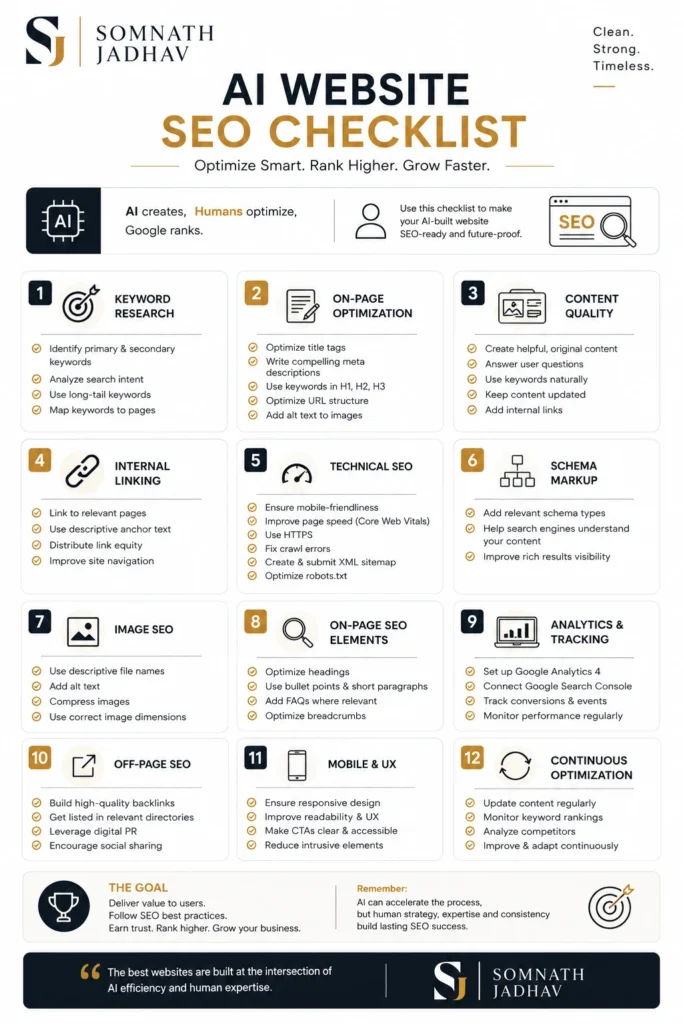
Before You Launch Your AI-Built Website
Before publishing your website, review these essential SEO fundamentals.
1. Review All AI-Generated Content
AI can generate website copy quickly, but it shouldn’t be published without review.
Before launching, make sure you:
- Edit AI-generated text for accuracy
- Add your own expertise and insights
- Remove repetitive or generic content
- Verify facts, statistics, and claims
- Ensure the content reflects your brand voice
Remember, AI should help create content—not replace human judgment.
2. Optimize Every Page
Every important page should include:
- A unique SEO title
- A compelling meta description
- One clear H1 heading
- Proper H2 and H3 headings
- Descriptive image alt text
- Clean, readable URLs
These on-page elements help search engines understand your content and improve click-through rates from search results.
3. Check Technical SEO
Before going live, confirm that your website includes:
- XML sitemap
- Robots.txt file
- HTTPS security
- Mobile-responsive design
- Fast page loading
- Structured data (Schema) where appropriate
- No broken links or missing pages
Technical SEO creates a strong foundation for search visibility.
4. Build a Clear Site Structure
A well-organized website helps both users and search engines navigate your content.
Your website should have:
- Logical navigation
- Clear page hierarchy
- Internal links between related pages
- Descriptive menu labels
- Important pages accessible within a few clicks
A simple structure improves user experience and makes it easier for search engines to crawl your site.
After You Launch Your Website
SEO doesn’t end when your website goes live. Ongoing optimization is essential for maintaining and improving search rankings.
5. Publish Helpful Content Regularly
Fresh, relevant content signals that your website is active and valuable.
Consider publishing:
- Blog articles
- Industry guides
- FAQs
- Case studies
- Customer success stories
- How-to tutorials
Consistent publishing also helps build topical authority in your industry.
6. Strengthen Internal Linking
As your website grows, connect related pages through contextual internal links.
For example:
- Link service pages to relevant blog posts.
- Link blog posts back to your main service pages.
- Connect related articles within the same topic cluster.
A strong internal linking structure improves navigation and helps search engines understand the relationships between your content.
7. Monitor Website Performance
Regularly review your website’s performance using SEO and analytics tools.
Track metrics such as:
- Organic traffic
- Keyword rankings
- Click-through rate (CTR)
- Bounce rate
- Core Web Vitals
- Page loading speed
Monitoring performance helps you identify opportunities for continuous improvement.
8. Keep Content Updated
AI, technology, and search engine algorithms evolve rapidly.
Review your website periodically to:
- Update outdated information
- Add new statistics or examples
- Refresh screenshots
- Improve readability
- Expand content where necessary
Regular updates help maintain relevance and improve long-term SEO performance.
Common SEO Mistakes to Avoid
Even with AI assistance, avoid these common mistakes:
❌ Publishing AI-generated content without editing
❌ Creating multiple pages targeting the same keyword
❌ Ignoring search intent
❌ Using duplicate page titles or meta descriptions
❌ Neglecting internal links
❌ Publishing thin or low-value content
❌ Ignoring mobile performance
❌ Forgetting to update content after launch
Avoiding these mistakes can significantly improve your website’s long-term search performance.
AI Website SEO Checklist
| Task | Status |
|---|---|
| Review and edit AI-generated content | ☐ |
| Create unique page titles and meta descriptions | ☐ |
| Optimize headings and image alt text | ☐ |
| Generate and submit an XML sitemap | ☐ |
| Enable HTTPS | ☐ |
| Test mobile responsiveness | ☐ |
| Improve page loading speed | ☐ |
| Add internal links between related pages | ☐ |
| Publish helpful, people-first content | ☐ |
| Monitor SEO performance regularly | ☐ |
| Update content periodically | ☐ |
The Future of AI Website Development: AI + Human Collaboration
Artificial intelligence is transforming website development at an unprecedented pace. Tasks that once required hours of manual work can now be completed in minutes, and AI capabilities continue to improve with every new generation of models.
However, this doesn’t mean web designers and developers will become obsolete.
The future of website development is unlikely to be AI versus humans. Instead, it will be AI working alongside humans, combining automation with creativity, strategic thinking, and technical expertise.
Businesses that successfully adopt this collaborative approach will be better positioned to build high-performing websites faster, more efficiently, and with greater long-term value.
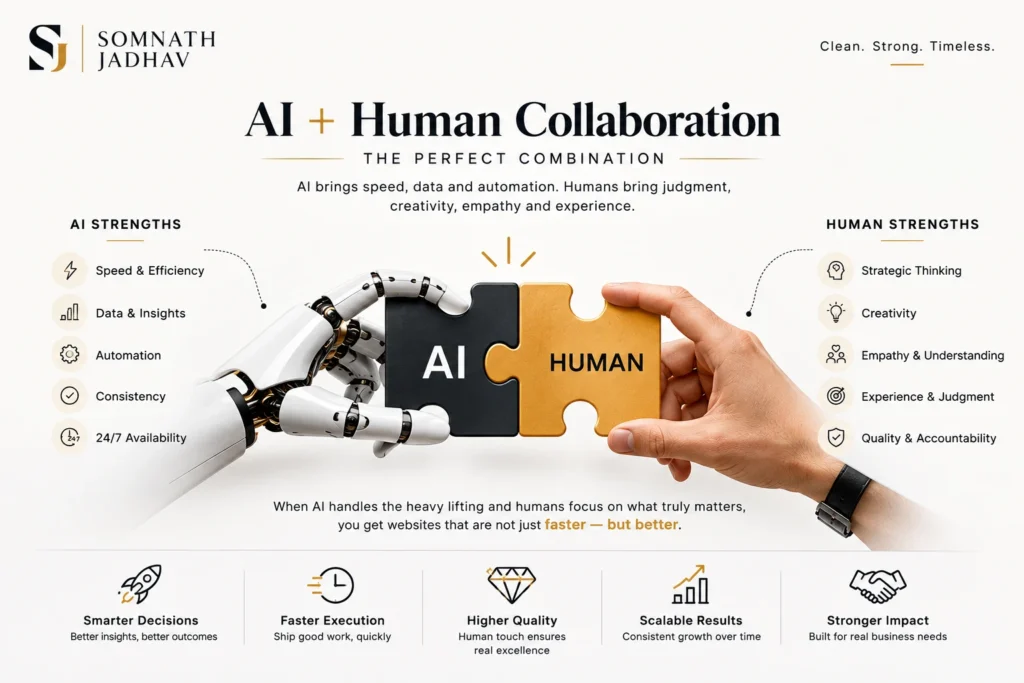
AI Will Continue to Automate Repetitive Tasks
As AI technology evolves, website builders and development tools will become increasingly capable of handling repetitive and time-consuming tasks
In the coming years, AI is expected to improve its ability to:.
- Generate complete website layouts
- Create high-quality content drafts
- Write and optimize code
- Recommend SEO improvements
- Generate images and design assets
- Detect usability and accessibility issues
- Assist with testing and quality assurance
These advancements will reduce development time and allow teams to focus on higher-value work.
Human Expertise Will Become More Valuable
While AI excels at automation, it cannot replace human understanding of business strategy, customer psychology, creativity, and decision-making.
Successful websites require more than attractive layouts or well-written content. They need a clear purpose, a strong brand identity, and an experience that builds trust and drives conversions.
Human expertise remains essential for:
- Business strategy
- Brand positioning
- User experience (UX)
- Conversion optimization (CRO)
- Technical architecture
- Complex integrations
- Customer relationships
- Long-term digital growth
AI can support these activities, but it cannot replace the experience and judgment behind them.
The Role of Web Professionals Is Evolving
Rather than replacing web professionals, AI is changing how they work.
Developers are spending less time writing repetitive code and more time solving complex technical challenges.
Designers are using AI to generate ideas and prototypes before refining them into polished user experiences.
SEO specialists are using AI to accelerate research and content creation while focusing on strategy, quality, and performance.
Agencies are shifting from simply building websites to delivering broader digital solutions that combine technology, marketing, automation, and business consulting.
In short, AI is changing workflows—not eliminating the need for skilled professionals.
What Businesses Should Do Today
Businesses don’t need to choose between AI and human expertise. The most effective approach is to use each where it delivers the greatest value.
Consider these best practices:
- Use AI to accelerate repetitive tasks and improve efficiency.
- Rely on human expertise for strategy, branding, and business decisions.
- Review all AI-generated content before publishing.
- Invest in long-term SEO, user experience, and website performance.
- Continuously adapt as AI technologies evolve.
This balanced approach helps businesses benefit from AI while maintaining quality, trust, and flexibility.
The Future Belongs to Businesses That Embrace Both
AI website development will continue to reshape how websites are planned, built, and maintained. Businesses that ignore AI may fall behind in productivity, while those that rely entirely on automation may struggle to differentiate themselves.
The greatest opportunities lie in combining the speed of artificial intelligence with the creativity, experience, and strategic thinking of people.
Rather than replacing human expertise, AI has the potential to amplify it.
Frequently Asked Questions About AI Website Development
What is AI website development?
AI website development is the process of using artificial intelligence to design, build, optimize, and maintain websites. AI-powered tools can generate layouts, content, images, and code from simple prompts, significantly reducing the time and effort required to create a website. While AI accelerates development, human expertise is still important for strategy, branding, SEO, and customization.
Can AI build a complete website?
Yes. Many modern AI website builders can generate a complete website, including page layouts, navigation, content, images, and basic SEO settings. However, businesses with complex requirements or custom functionality may still require professional development and ongoing optimization.
Are AI website builders free?
Many AI website builders offer free plans or free trials, allowing users to create and test websites before upgrading. However, publishing on a custom domain, accessing premium templates, removing branding, or using advanced features usually requires a paid subscription.
Which AI website builder is best?
There is no single best AI website builder for every business. The right choice depends on your goals. Wix AI is popular for beginners, Framer AI is known for modern designs, Hostinger Website Builder is budget-friendly, Shopify Magic is ideal for eCommerce, and 10Web is well suited for WordPress users.
Can AI-built websites rank on Google?
Yes. Google does not rank websites based on whether they were built with AI. Rankings depend on the quality of the content, user experience, technical SEO, website performance, and how well the site satisfies search intent. AI-built websites can perform just as well as traditionally developed websites when properly optimized.
Is AI replacing web developers?
No. AI is changing how web developers work rather than replacing them. It automates repetitive tasks such as generating layouts, code suggestions, and content drafts, allowing developers to focus on strategy, custom functionality, user experience, and solving complex business problems.
Is AI website development secure?
AI website development can be secure when built on reputable platforms and combined with good security practices. Businesses should choose trusted providers, enable HTTPS, keep software updated, use strong authentication, and review the platform’s privacy and security policies before publishing their website.
Can ChatGPT build a website?
ChatGPT can help generate website code, content, page structures, wireframes, and development guidance. However, it is not a complete website builder. To publish a website, you’ll typically use ChatGPT alongside website builders, development frameworks, or hosting platforms.
Can Claude create websites?
Yes. Claude can generate HTML, CSS, JavaScript, website copy, and development recommendations. Like ChatGPT, Claude acts as an AI coding assistant rather than a complete website builder. Developers often use it to accelerate coding, planning, debugging, and content creation.
Can AI build an eCommerce website?
Yes. Many AI website builders support eCommerce websites by generating product pages, store layouts, descriptions, and basic online store functionality. Small and medium-sized online stores can often be built successfully with AI, while enterprise eCommerce projects may require custom development.
How much does AI website development cost?
The cost varies depending on the platform and project requirements. Many AI website builders offer affordable monthly plans, making them suitable for individuals and small businesses. More advanced websites that require custom functionality, integrations, or professional services will generally involve higher development costs.
Are AI-generated websites customizable?
Yes. Most AI-generated websites can be customized after they are created. Users can modify layouts, colors, typography, content, images, navigation, and other design elements. However, the level of customization depends on the platform, with custom-developed websites offering the greatest flexibility.
What types of businesses benefit most from AI website development?
AI website development is particularly beneficial for startups, small businesses, freelancers, consultants, local businesses, portfolio websites, and many eCommerce stores. Businesses that require complex workflows, enterprise systems, or highly customized functionality may benefit more from traditional or hybrid website development.
Do I need coding skills to use an AI website builder?
No. Most AI website builders are designed for users with little or no coding experience. They use conversational prompts, drag-and-drop editors, and automated website generation to simplify the development process. Basic technical knowledge can still be helpful for advanced customization.
What is the future of AI website development?
The future of AI website development lies in collaboration between artificial intelligence and human expertise. AI will continue to automate repetitive tasks, improve productivity, and simplify website creation, while professionals will focus on strategy, branding, user experience, SEO, and custom development. Businesses that combine both approaches are likely to achieve the best long-term results.
Key Takeaways
- AI website development dramatically reduces development time.
- AI website builders are ideal for many small and medium-sized websites.
- Human expertise remains essential for strategy, branding, and complex functionality.
- AI-generated websites can rank on Google when properly optimized.
- Choosing the right AI tool depends on your goals and technical requirements.
- Hybrid AI + human development offers the best balance for many businesses.
- Website quality depends more on execution than on whether AI was used.
- AI will continue to reshape website development, but collaboration—not replacement—is the future.
Conclusion: Is AI Website Development Right for You?
AI website development is no longer a futuristic concept—it’s becoming a standard part of how modern websites are planned, designed, and built. From generating layouts and content to assisting with coding and SEO, artificial intelligence has made website creation faster, more accessible, and more affordable than ever before.
However, as we’ve explored throughout this guide, AI is not a one-size-fits-all solution. While AI website builders are an excellent choice for many startups, small businesses, portfolios, and online stores, they still have limitations when it comes to advanced customization, complex integrations, long-term scalability, and strategic digital growth.
The businesses that will benefit the most are not those that rely entirely on AI—but those that combine AI’s speed with human expertise.
Artificial intelligence can automate repetitive tasks, accelerate development, and improve productivity. Human professionals bring creativity, strategic thinking, technical expertise, and a deep understanding of customer needs. Together, they create websites that are not only faster to build but also more effective at generating leads, building trust, and supporting business growth.
Whether you’re launching your first website, redesigning an existing one, or evaluating AI website builders for your next project, the key is to choose the approach that aligns with your goals, budget, and long-term vision.
Technology will continue to evolve, but the fundamentals of a successful website remain the same: provide value to your audience, create a great user experience, optimise for search engines, and continuously improve based on real-world results.
Final Thoughts
AI won’t replace great websites.
AI won’t replace great developers.
AI won’t replace great businesses.
But businesses and professionals who learn to use AI effectively will have a significant advantage over those who don’t.
The future of website development isn’t AI or humans.
It’s AI and humans working together.
Ready to Build a Smarter Website?
Whether you’re exploring AI website builders or need a custom website that combines the power of AI with professional design, development, and SEO, choosing the right strategy is more important than choosing the latest tool.
If you’d like expert guidance on selecting the best approach for your business, we’re here to help.
Explore our services:
Or contact us to discuss your website project and discover how AI and human expertise can work together to build a website that supports your long-term business goals.